The island nation of Cyprus is small but offers a surprisingly diverse selection of listed companies. This includes Bank of Cyprus, Petrolina Holdings, and DCI Advisors.

Cyprus – “weird” opportunities galore
read more

When Venezuelan dictator Maduro was seized by the US military, the geopolitical balance in the region shifted overnight.
Venezuela had long threatened to invade neighbouring Guyana – a risk that has now effectively disappeared.
For investors, the more relevant point is economic momentum. Guyana is one of the world's fastest-growing economies, having expanded its GDP sevenfold over the past seven years and expecting a further 19.3% growth in 2026.
It's a good moment to revisit the country as an investment destination.

In November 2024, I published a long-read feature about investing in Guyana.
For a deeper dive into the country's history and the full array of available investments, see "Guyana and the mystery of the largest ranch of the Americas".
Following the discovery of gargantuan oil reserves, Guyana had already begun to gain strategic importance. However, development of these reserves (as well as others) was constrained for years by Venezuela's claim over the Essequibo region. That disputed area represents two-thirds (!) of Guyana's landmass and contains a disproportionate share of its natural wealth.

Source: OilPrice.com, 27 January 2026.
There are numerous Guyana-linked stocks listed on Western exchanges, as well as several on the Guyana exchange. Accessing the latter is possible but administratively cumbersome. Many foreign-listed firms, meanwhile, only make a small portion of revenue from the country or suffer from limited liquidity.
Two exceptions stood out: ExxonMobil (ISIN US30231G1022, NYSE:XOM) and Omai Gold Mines (ISIN CA6820431048, CA:OMG).
Canada-listed Omai Gold Mines has already benefited from the rising gold price, but the stock received an additional boost after Maduro's arrest. When I highlighted it as Guyana's only viable gold miner, its market cap stood at CAD 90m. It now sits around CAD 1.3bn – a tenfold increase. Fittingly, the company's ticker symbol is "OMG", a widely recognised exclamation meaning "Oh My God", used to express shock, surprise, or excitement.

Omai Gold Mines.
The oil story has followed a similar trajectory, albeit on a larger scale. ExxonMobil was trading at USD 120 just before the events on 3 January 2026 – roughly the same level at which I had previously featured it as THE oil play on Guyana. Over the subsequent weeks, the stock rallied to USD 141.
Following that rapid move, the natural question arises: is the opportunity already exhausted, or does further upside remain?
For an author specialising in niche subjects, few moments are more satisfying than seeing a once-obscure theme move into the mainstream.
On 21 January 2026, UBS published a 28-page "Guyana Deep Dive". What was previously an exotic idea is now firmly on the radar of major investment banks.
The report focuses in particular on ExxonMobil's growth plans in the country.

ExxonMobil.
ExxonMobil originally discovered the massive Stabroek oil field in 2015. Guyana's ultra-deepwater offshore zone – about 3.5 times the size of New Jersey – contains 11bn barrels of known reserves. A decade after the discovery, the country, with a population of just 400,0000 people, has already become Latin America's fifth-largest crude exporter (after Brazil, Mexico, Venezuela, and Colombia). A top-three ranking in the region now appears plausible.

With a 45% stake in the Stabroek Block, ExxonMobil is the largest stakeholder in Guyana's oil reserves. During Q3/2025, average production reached 700,000 barrels per day (bpd), rising to 900,000 bpd by November 2025. By 2030, the company aims to produce 1.7m bpd from Guyana alone.
Even for a global giant like ExxonMobil, that scale is becoming increasingly material. Between 2026-2030, Guyana is projected to contribute nearly 14% of the company's total oil output and close to 28% of its international production.
ExxonMobil also enjoys structural advantages. It pays only a 2% royalty rate on the Stabroek Block, compared to 10% for newer entrants. As the UBS report put it, the company may increase its Guyana targets even further: "Exxon continues to develop its advanced digital and subsea technologies, along with its proprietary AI drilling system – a gamechanger for growing Guyana production."
Guyana is blessed with relatively low production cost. Even at an oil price of just USD 65 per barrel, the Stabroek assets are expected to generate annual free cash flow of about USD 3.9bn between 2026-2030 and USD 5.5bn between 2026-2036.
UBS last published detailed estimates for ExxonMobil in early November 2025, when the stock traded at around USD 120. While the share price has since appreciated, the company's fundamentals remain compelling to many observers – particularly given the scale of its operations and its well-known political backing.
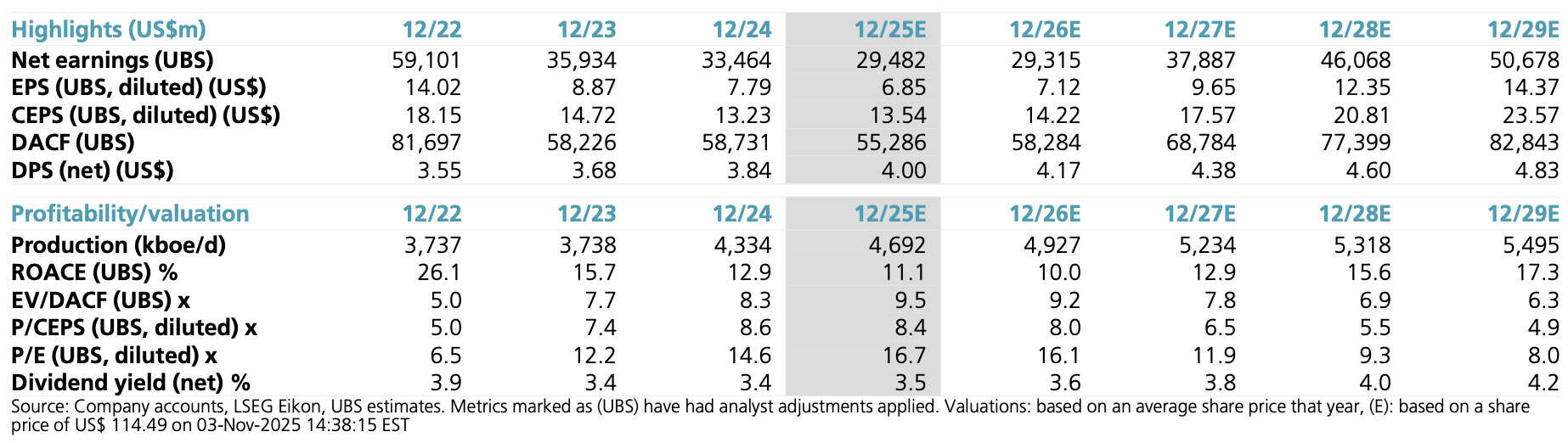
Source: UBS, 3 November 2025 (click on image to enlarge).
ExxonMobil is not the only major beneficiary. A comparable opportunity exists via Chevron (ISIN US1667641005, NYSE:CVX). In 2023, Chevron bid for Hess, an early entrant into Guyana. After a legal dispute with ExxonMobil over rights of first refusal, Chevron successfully closed the deal in July 2025.
Chevron holds a 30% interest in the Stabroek field. While smaller than ExxonMobil's stake, the proportional impact on Chevron's future cash flows is similarly meaningful. The two firms differ mainly in their broader geographic strengths – ExxonMobil in the US Permian Basin, Chevron in Venezuela and the Eastern Mediterranean.
All of this is explored in considerably more depth in the UBS report. Anyone wishing to receive a copy, get in touch (just put "UBS Guyana" as the subject).
Seeing a major investment bank examine Guyana in such detail is a clear sign of the theme's transition from frontier curiosity to mainstream investment narrative. Guyana is no longer obscure – but it is still early in its economic and investment cycle.
The next time an unfamiliar country with limited access or few pure-plays appears on the radar, don't laugh it off. Today's exotic idea can become tomorrow's consensus trade!
This special episode takes a deep dive into the performance of past investment picks.
Join Anton Gneupel of D wie Dividende, fellow investor Norbert Schmidt and myself as we revisit the ideas that aimed for double-digit returns. Which ones hit their targets, which ones surprised, and which key lessons can investors draw from both the successes and the challenges?
This special episode takes a deep dive into the performance of past investment picks.
Join Anton Gneupel of D wie Dividende, fellow investor Norbert Schmidt and myself as we revisit the ideas that aimed for double-digit returns. Which ones hit their targets, which ones surprised, and which key lessons can investors draw from both the successes and the challenges?
Did you find this article useful and enjoyable? If you want to read my next articles right when they come out, please sign up to my email list.
Share this post:


