In 2020, I featured Wimbledon Debentures while they were deeply out of favour. Following their spectacular recovery, it’s worth revisiting this unusual investment.

Weird and wonderful debentures – Wimbledon and beyond
read more

One of the EU's smallest member states, Cyprus harbours some remarkable investment opportunities.
Four years ago, I ignored the warnings of locals and tipped Bank of Cyprus.
The stock is up 800% since.
I also featured Petrolina Holdings, a company with an incredible hidden asset. News that emerged earlier this week makes it a timely moment to revisit the story.

Yours truly on Cyprus' Madari hiking trail earlier this week.
What Cyprus lacks in size, it makes up for with an unusual history.
Surprisingly, this also applies to its stock market.
Few people are even aware that Cyprus has its own stock exchange. Yet, a generation ago, it made frontpage headlines around the world.
In 1999, the main index of the Cyprus Stock Exchange rose nearly tenfold, making it the world's best-performing stock market.
It was one of history's greatest investment manias:
The business section of Britain's The Guardian reported at the time:
"Everyone, housewives, cleaning ladies, ministers and businessmen are in on the act … The mania has reached such heights that from Cyprus' taverna-terraced beaches to its remote mountain villages few now talk of anything else."
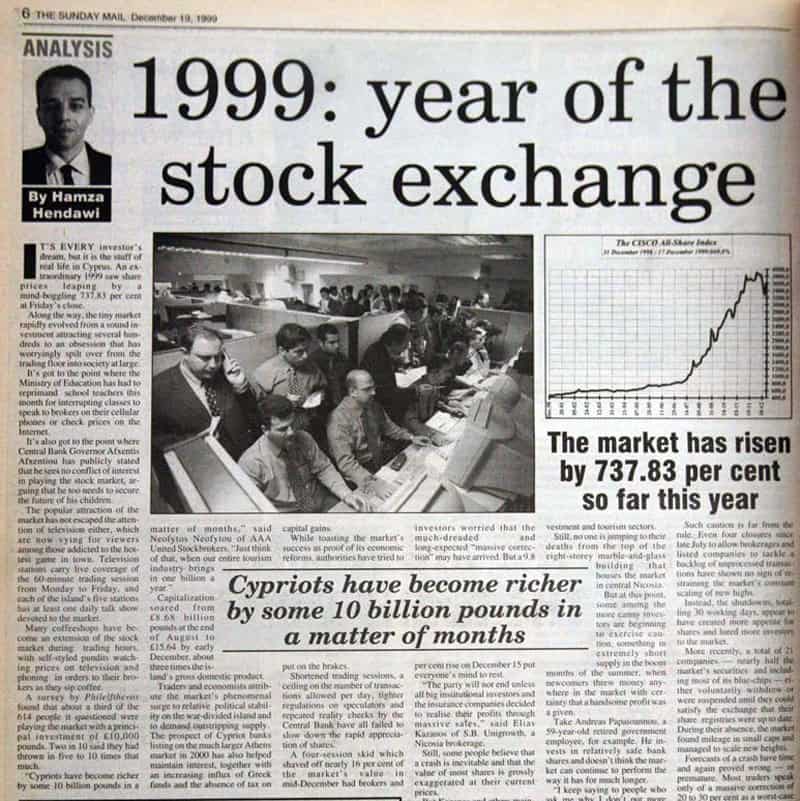
Source: Cyprus Mail (archive).
It ended much like almost every investment mania ends: in tears.
After breaking records on the way up, the Cypriot stock market broke records on the way down, too. The market index ultimately lost 99%, which, according to some, remains the largest decline ever suffered by a national stock market index. By comparison, Greece "only" lost 92.5% during its sovereign debt crisis, while Germany's hyperinflation between 1918-1922 saw the market fall by 97%.
Many Cypriots lost their life savings, and the government launched an inquiry into fraudulent IPOs and other alleged wrongdoing. At the time, some described it as "the biggest collective crime perpetrated against the people in the history of Cyprus".
No one was ever jailed over these alleged crimes. Cynics remarked that Cypriots were simply compulsive gamblers who had brought this upon themselves. Contemporary statistics did show that betting had long been exceptionally popular on the island, with Cyprus reportedly having more gamblers per capita than anywhere else in the world.
Whatever the explanation, the market subsequently disappeared from investors' radar screens.
Of course, a market that is remote, obscure, or unpopular immediately catches my attention.
In 2022, I noticed during a visit to Cyprus how fervently locals disliked Bank of Cyprus (ISIN IE00BD5B1Y92, GR:BOCH).
At the time, the stock was listed on the London Stock Exchange (it has since moved its primary listing to Greece).
I researched the situation in more detail and found the bank's actual prospects to be considerably more promising than local sentiment suggested. In particular, I noticed that foreign investors seemed keen to take control of the bank. What did they know that the locals didn't?
On 21 September 2022, I published my article "Bank of Cyprus – imminent bidding battle?"
A lot has happened since. The share price has risen from EUR 1.22 to EUR 10.33.

Bank of Cyprus.
Of course, Bank of Cyprus hasn't been alone. Since 2022, most European bank stocks have rallied several-fold. The sector went from struggling during the era of zero interest rates to minting money once interest margins returned.
In Cyprus, however, this trend has been amplified by limited competition. As I explained in more detail at the time, Bank of Cyprus is now effectively part of a banking duopoly. The country's financial crisis wiped out much of the sector, leaving the remaining banks in an exceptionally strong competitive position. Now that the island's economy has recovered, they are reaping the rewards.
The combination of a booming economy and a steady influx of wealthy, entrepreneurial immigrants also prompted me to take a closer look at another interesting Cypriot company.
On 4 November 2022, I published a lengthy article entitled "Petrolina Holdings – a secret Cyprus real estate fund".
To this day, I believe it remains the most comprehensive summary of what has been happening at Petrolina Holdings (ISIN CY0006310615, CYS:PHL), a Cyprus-listed company established in 1959 by four brothers.
Petrolina Holdings was Cyprus' first oil company. Today, it supplies motor, industrial, domestic, marine, and aviation fuels, and operates a nationwide retail network of 95 petrol stations in Cyprus and a further 223 in Greece.
With 87.5m shares outstanding and a share price of EUR 1.21, the company currently has a market cap of just EUR 105m.
What originally caught my attention was an old refinery site owned by the company. Once a cheap industrial area, the land had gradually become adjacent to an expanding urban area that developers had begun taking a serious interest in.
Cyprus is best known for Limassol (its high-rise buildings), Paphos (the greener part of the island), and Ayia Napa (its nightlife). Larnaca had long been the forgotten, less fashionable part of the country.
As I described at the time, that had already begun to change.
Larnaca is home to one of Cyprus' two international airports (the other being Paphos). With cheaper real estate, attractive beaches, and the airport on its doorstep, the redevelopment of Larnaca always seemed inevitable.
Against the backdrop of Cyprus' property boom, the Municipality of Larnaca approved the redevelopment of a 7km (4.4 miles) stretch of previously underutilised coastline. As it happened, Petrolina Holdings owned a substantial portion of this land.
Recognising the opportunity to monetise its assets more effectively, Petrolina Holdings decided to relocate parts of its core operations elsewhere on the island, thereby freeing up the coastal land for redevelopment.

Source: Feasibility Study for the Regeneration of the East Coast of Larnaca (2016).
My article summarised everything that was known at the time.
It also pointed out several important uncertainties:
Even so, I encouraged interested readers to investigate the story further.
During my 48h whirlwind visit to Cyprus earlier this week, I came across a headline that confirmed it all.
The Cyprus Mail, the island's oldest English-language newspaper, reported: "Petrolina moves forward with massive coastal development plan".
Two weeks earlier, the (somewhat obscure) local news website In-Cyprus had already revealed further details:
"The site of Larnaca's former oil refineries is set for a radical transformation under a €533 million development project called 'Land of Tomorrow.' … Details of the scale and scope of the project have emerged in an Environmental Impact Assessment Study (EIAS) submitted to the relevant authority for approval of the General Town Planning Study. According to the study, Petrolina (Holdings) Public Ltd is planning a large-scale, mixed-use development combining residential, business and leisure functions. The development site includes parcels where Larnaca's former refineries once operated, covering a total area of 298,342 square metres along the coastal front. The Master Plan sets out a holistic approach with a mix of land uses."
As it happened, while travelling back to London the evening before publishing this Weekly Dispatch, I even spotted advertising for "Land of Tomorrow" inside Larnaca Airport. Fittingly, the airport itself is currently undergoing a major redevelopment to cope with the ever-growing visitor flow.
Clearly, things are moving.
The question is: what's in it for shareholders?
Allegedly, we live in an age where virtually any information imaginable is available at our fingertips.
Looking into Cyprus-listed companies reminded me just how valuable travelling and gathering intel still is.
Cyprus is widely recognised as an economy that is doing well, but the scale and breadth of the island's rejuvenation are difficult to appreciate until you visit.
On the drive from the airport to your hotel, you'll notice the large number of billboards advertising innovative, technology-focused companies.
The quality of the hospitality industry is noteworthy, as is the excellent value for money.
(If you want a recommendation, treat yourself to dinner at the M Fusion Peruvian-Japanese restaurant at the Four Seasons Hotel outside Limassol. The food is outstanding, the service excellent, and the sea views spectacular. Afterwards, you can round off the evening with a 'Bitcoin cocktail' at the neighbouring Vista Terrace bar, described in the cocktail menu as "Sweet like the earnings, spicy like the risk." Best of all, you don't leave feeling like you've been robbed. Altogether, it's easy to see why Cyprus continues to strengthen its tourism appeal.)
Cyprus lies outside the Schengen Area, and despite being a member of the EU, it visibly does things its own way – as island jurisdictions often do.
The influx of economically active and financially secure new residents is evident wherever you look. I doubt this trend will slow down anytime soon. If anything, it may accelerate. After all, how many attractive European jurisdictions remain if you are German, British, or French and looking to relocate somewhere with a better climate – not just in terms of weather, but politically and economically as well?
As I concluded in my 2022 article:
"I have no doubt that Cyprus will become even more of a haven for people to flee to. There are few alternatives within Europe for people to find similarly attractive conditions, and the island now has a lot of momentum on its side. In terms of affordability, logistical access, and open doors to well-to-do immigrants, Cyprus ticks many boxes. Not unimportantly, the island also has a lot of space to accommodate new residents, as well as some other potential aces up its sleeve, such as its offshore gas reserves."
It wouldn't be a place for me, and I'm sure one could also find plenty to criticise.
However, nowhere is perfect, and Cyprus appears to offer enough positives to continue along its current trajectory. (And that's before even mentioning Northern Cyprus as a separate investment jurisdiction, which, during a previous visit, I was fortunate enough to tour with a locally resident reader.)
Had I visited with more time on my hands, I would have:
Being a little short on time during this visit, I wonder whether one of my readers would like to take up the challenge?
Petrolina Holdings is probably quite an undervalued gem as far as its land holdings are concerned. Given that there are around 100,000 publicly listed securities worldwide, Undervalued-Shares.com can only examine a tiny fraction of them in any depth. Hopefully, one of my readers will feel inspired to dig deeper.
Who knows, perhaps even the locals will one day start investing again? After all, they have already missed out on substantial gains by ignoring Bank of Cyprus. Nothing rekindles FOMO quite like watching a major opportunity pass you by.
And if Petrolina Holdings isn't practical for you, I have another idea (or two).
The biggest drawback of Petrolina Holdings is that investing requires a local brokerage account. That's a lot of effort just to buy a single stock.
Fortunately, there is another investment with a strong Cyprus angle that is considerably easier to access. DCI Advisors (ISIN GG00BSWT8V72, UK:DCI) is a London-listed real estate holding with substantial land holdings across several parts of the Mediterranean, much of them in Cyprus. ALL of its real estate is currently in various stages of being sold, with the intention to return all capital to shareholders.
Despite this, the stock continues to trade at a discount of more than 50% (!) to net asset value, even though the company appears well on course to complete its liquidation. The business is headed by an activist investor with an established track record of winding up closed-ended funds. I covered the company in much greater detail in research available exclusively to Undervalued-Shares.com Lifetime Members. This has the potential to be a relatively low-risk double.
Alternatively, you can learn more about outlier opportunities like these: join us at next week's Weird Shit Investing Online conference!

"This is the best fucking conference of my entire life."
Over the past three years, Weird Shit Investing events in Hong Kong, London, and New York have been hugely popular.
Capped at just 30 participants per location, these invite-only events attracted far more demand than available places.
For the first time ever, anyone can join a Weird Shit Investing event online – and more than 200 investors have already secured their place.
Join them at Weird Shit Investing Online on Tuesday, 28 July 2026.
Expect opportunities that are too obscure, too niche, too controversial, or simply too unconventional for mainstream investment conferences.
Can't make it live? Your ticket includes recordings of every session, so you won't miss a thing. (Members also receive a discounted ticket price.)
Did you find this article useful and enjoyable? If you want to read my next articles right when they come out, please sign up to my email list.
Share this post:


