The island nation of Cyprus is small but offers a surprisingly diverse selection of listed companies. This includes Bank of Cyprus, Petrolina Holdings, and DCI Advisors.

Cyprus – “weird” opportunities galore
read more

I had mobilised GBP 30m (USD 40m), but ultimately could not agree on a transaction. My colleagues and I then decided to set the matter aside for two years.
Since then, however, the questions have not stopped. People now ask me about Sark not only by email but at meetings, conferences, and even at airports. Investors keep approaching me with offers of money to deploy into Sark, and many struggle to understand why I continue turning them down.
Given that we are halfway through our company's two-year hiatus, here is an update.
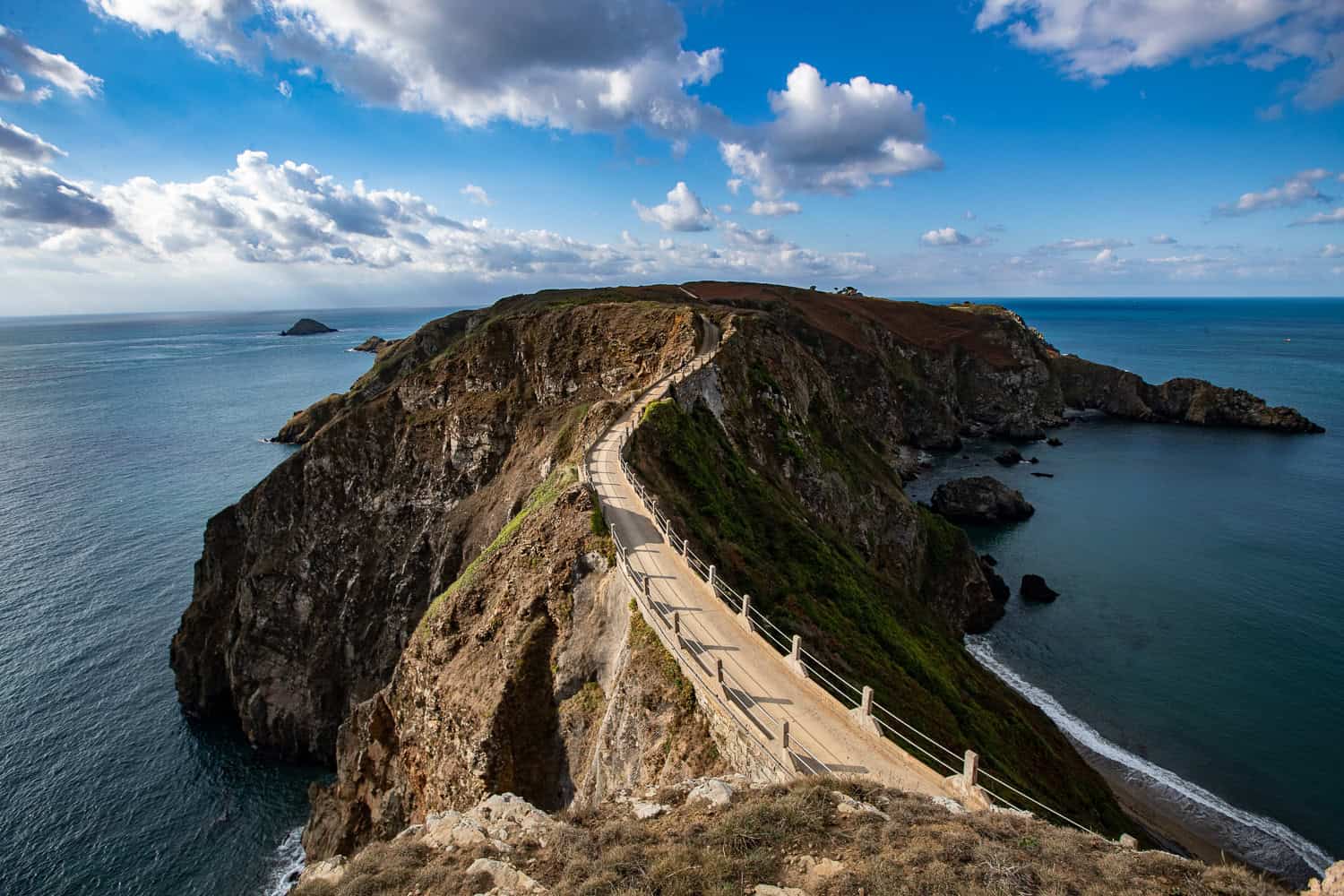
Sark is an autonomous island between the United Kingdom and France. It has just 500 residents and a land mass that is a minuscule 1.5x the size of New York's Central Park. Despite its tiny size, Sark has its own head of state, parliament, and even tax system. It is not part of the UK and has never been part of the European Union. Its autonomous status has been in place since 1565, and was granted by the English Crown "in perpetuity". It is also quite simply a beautiful place and widely seen as "the Jewel of the Channel Islands".

As a so-called Crown dependency, it's technically not a full-blown country – though in practical terms, it is. Since September 2024, Sark has even had its own flag emoji on Android and iOS.
You can read my previous articles here, here, here, and the most recent one (from November 2024) here.
Over the past two decades, the island has struggled with multiple issues:
Together with colleagues and friends, I registered the Sark Property Company (SPC) in Guernsey to raise and deploy an initial GBP 30m, with a view to raising up to another GBP 200m via an IPO on the London Stock Exchange. Our goal was to purchase up to 40% of the island and facilitate its gradual, sympathetic development while helping its long-term resilience. We had signed up a variety of carefully selected partners, such as a town planning organisation closely affiliated with King Charles III, The King's Foundation.
When our bid failed, I predicted that Sark would continue to decline further. In November 2024, I wrote: "As a company, we believe Sark will only leave its current downward trajectory once the island's key stakeholders get serious – and honest – about the scope of the problems and the funding requirements to resolve them. … 2025 should bring plenty of news in that regard. I fear that much of it won't be to the liking of resident taxpayers and existing real estate owners. "
At the time, I kept the tone reasonably mild to avoid sounding like "sour grapes".
Now, a year later, I can be a bit more outspoken: even I did not expect Sark's challenges to snowball this quickly.
After years of gradually eating up its financial reserves, Sark has now introduced a chunky tax increase. Residents are concerned that the parliament's Tax Review Committee is considering a fundamental overhaul (see following article).
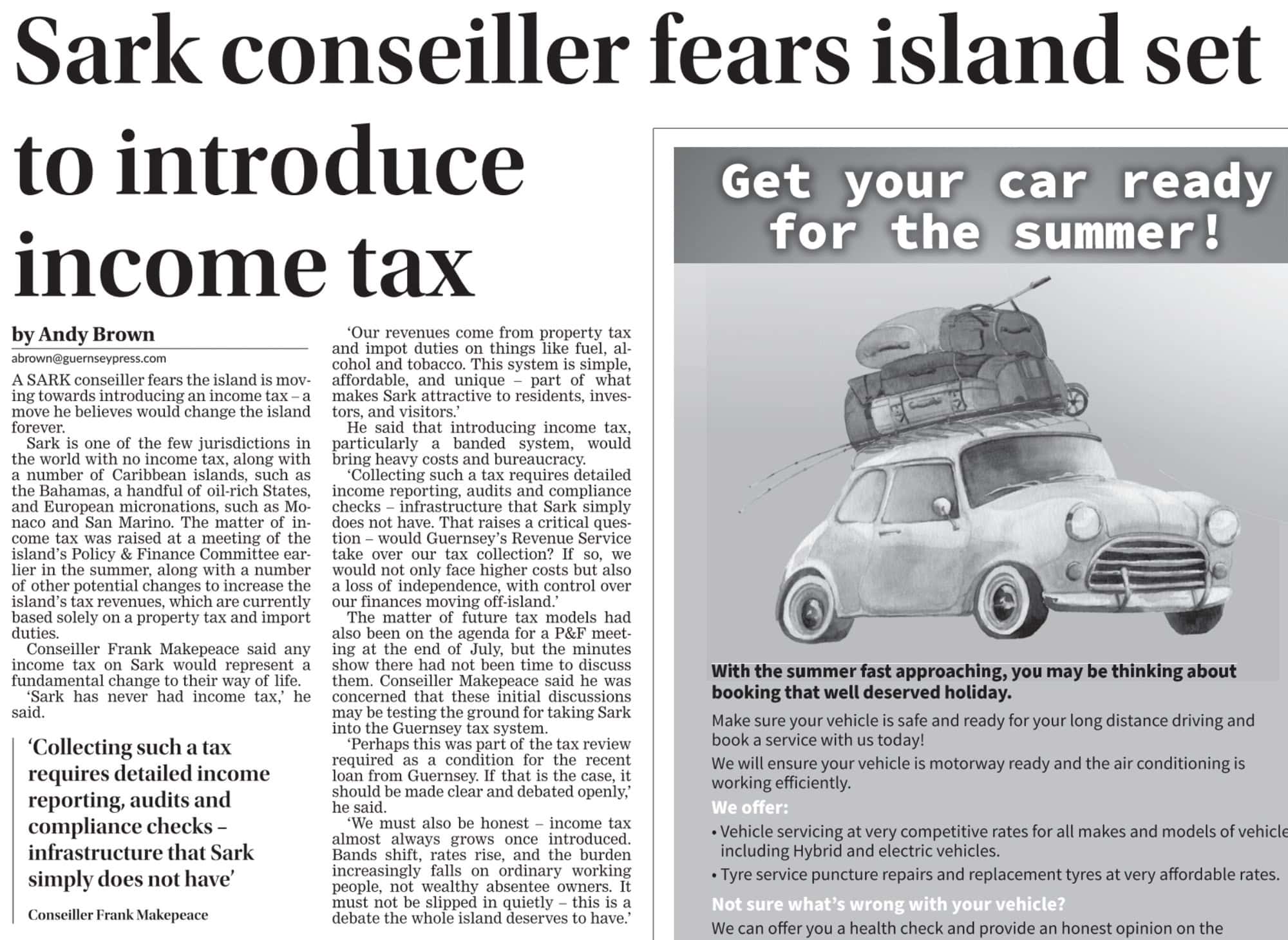
Some are laughing off fears, believing this is merely a recurring debate that will again lead nowhere. But this time may be different. At the 19 November 2025 debate on the 2026 budget, Sark's parliament explicitly confirmed that Sark's legislative body will be "debating and having a big public consultation next year about a fairer way of raising tax and revenue for the island to cover the work that needs doing. There is no escaping it." (temporarily available as a recording of the session).
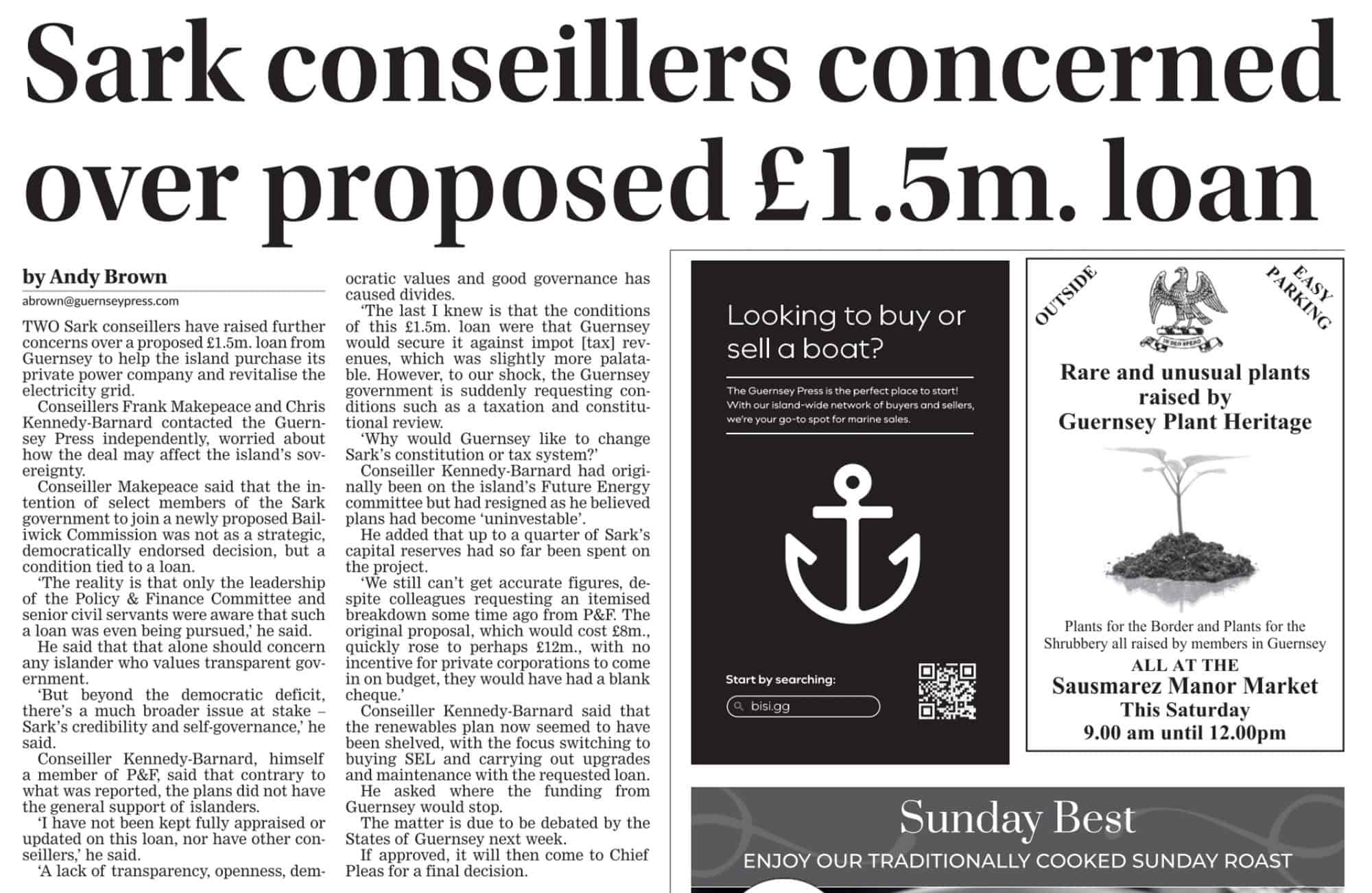
Meanwhile, Sark's parliament has formally requested a GBP 1.5m loan from neighbouring island, Guernsey. A previous attempt to obtain a bailout from an entity linked to the Crown unsurprisingly failed – imagine UK taxpayers rewarding a fiscal haven that failed to sufficiently provision for obvious financial needs for years.
Financially, Sark has reached the end of the road, and had to pledge its future alcohol tax revenue as collateral to secure the loan from Guernsey's government. Will this prove the first step toward debt servitude or even a loss of the incredible degree of autonomy that Sark has enjoyed for centuries? The question is being asked by some (see article below).
The precise nature of Sark's future tax regime aside, a number of accumulated issues are now coming to the fore:
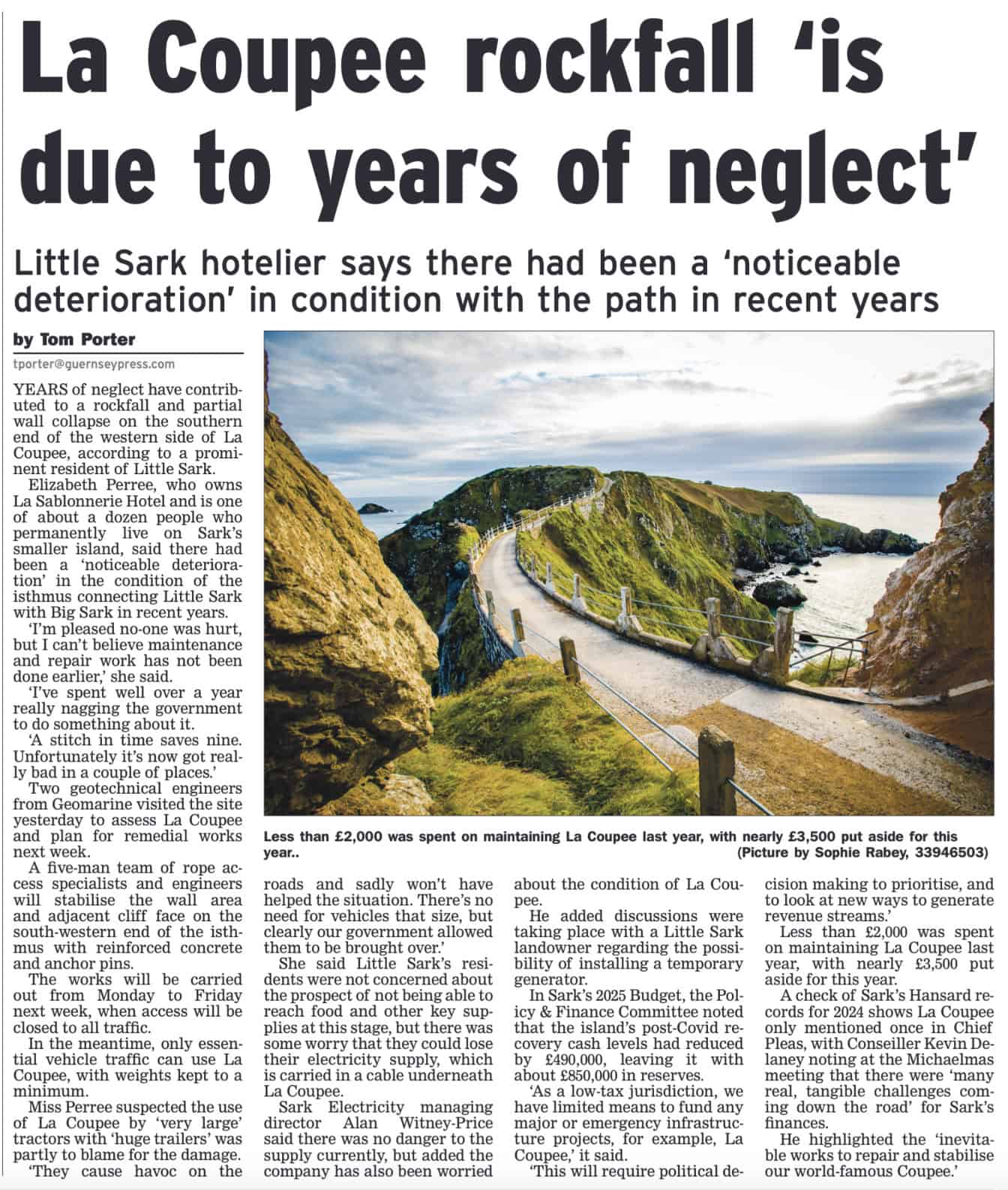
The island may be small, but the problems are not.
Eventually, someone will have to pay for at least some of it.
In 2024, Sark's government ran a survey on new revenue options. The population's clear preference was a tax on empty, derelict buildings – the public's #1 choice for raising additional revenue. The island is blighted by numerous dilapidated structures at a time when it must compete for tourism, and simultaneously faces a housing shortage and an affordability crisis. Vox populi pointed Sark's elected representatives toward the seemingly obvious solution. As the Guernsey Pressreported: "More than 50% of respondents gave full marks to the ideas of introducing a tax on derelict buildings to encourage development and taxing newly-arrived residents."
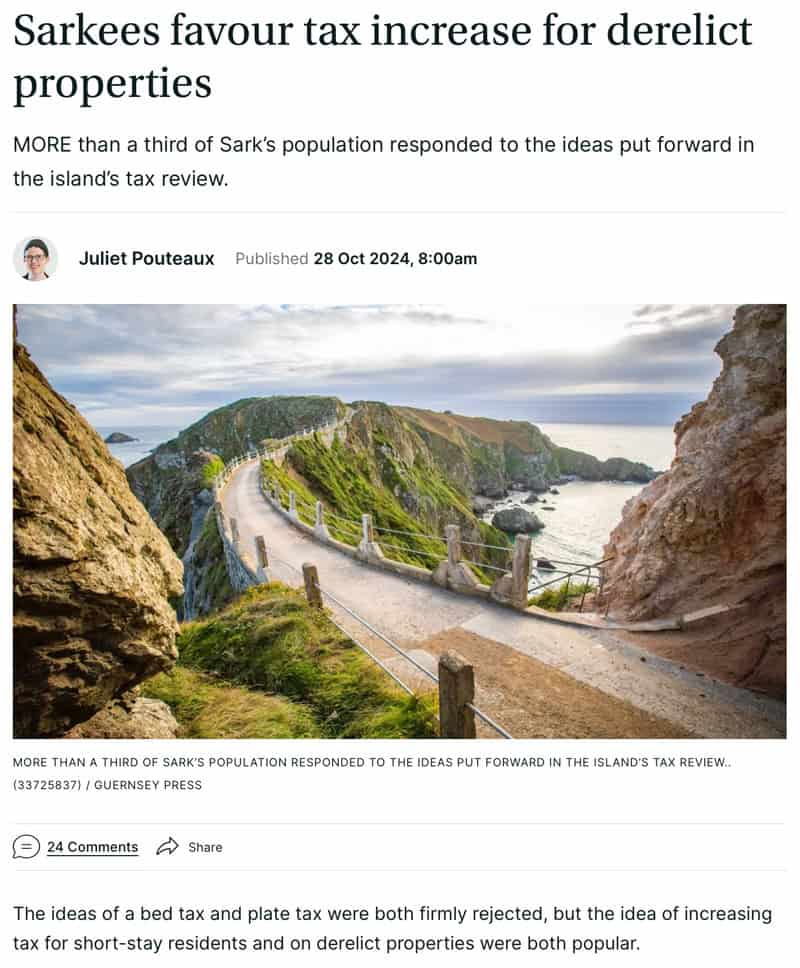
Source: Guernsey Press, 28 October 2024.
However, Sark politicians didn't act on this preference. Instead, they have now increased personal taxation for all residents. Many conventionally employed or retired islanders are already struggling with ever-rising living costs, even before factoring in further tax hikes, which now seem inevitable as early as fiscal 2027.
In a small community, dealing with issues of this magnitude inevitably creates friction. The situation has contributed to significant polarisation within Sark's parliament, culminating in a recent battle royale fought through a series of articles and letters published in the local gazettes.
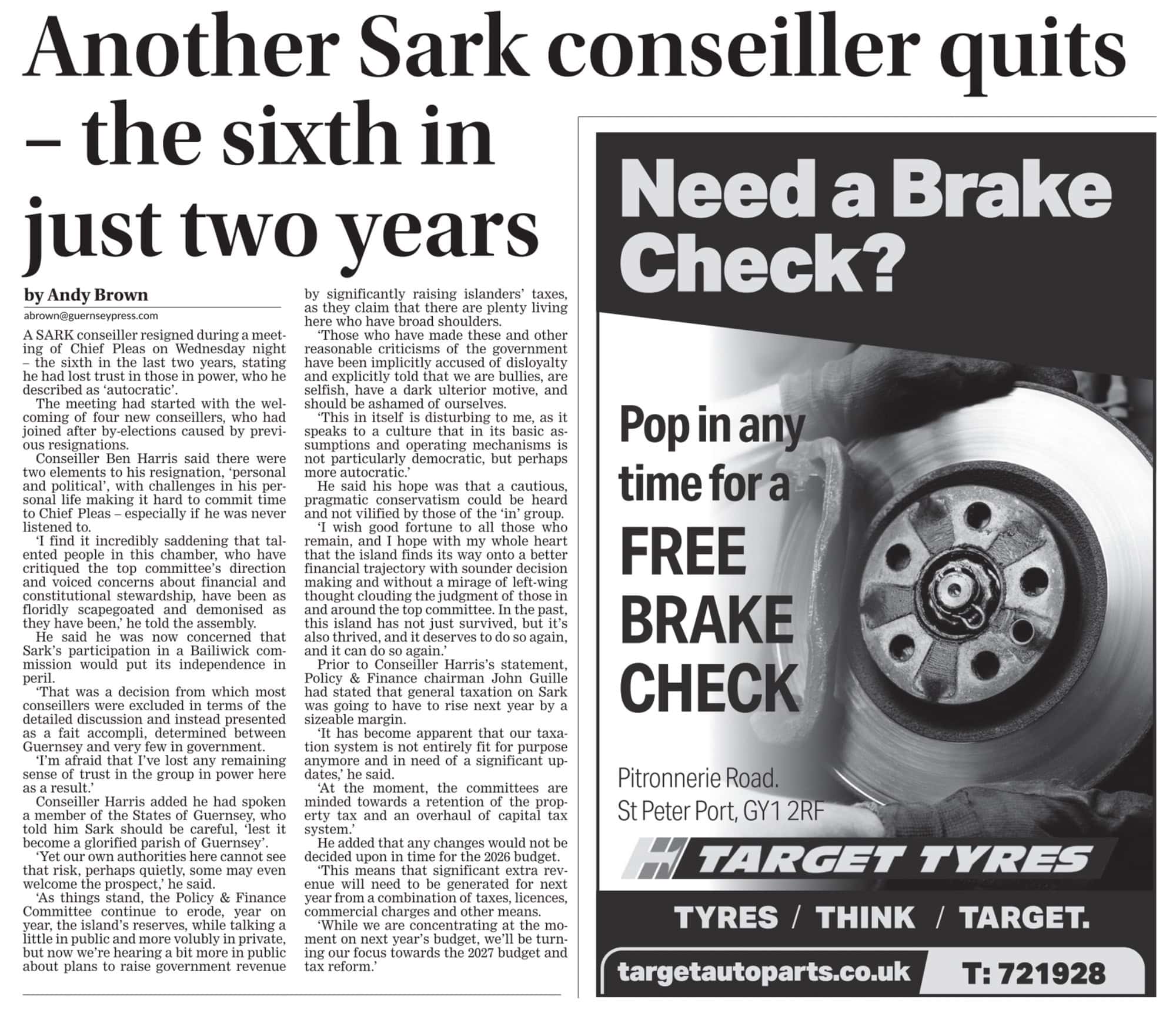
Out of Sark's 18 members of parliament, six have chosen to step down in just two years. One of them delivered a scathing review of Sark's governance to the Guernsey Press (see article below).
Another (now former) member, active in international real estate, called for further economic development of the island to avoid Sark "having to be bailed out by Guernsey".
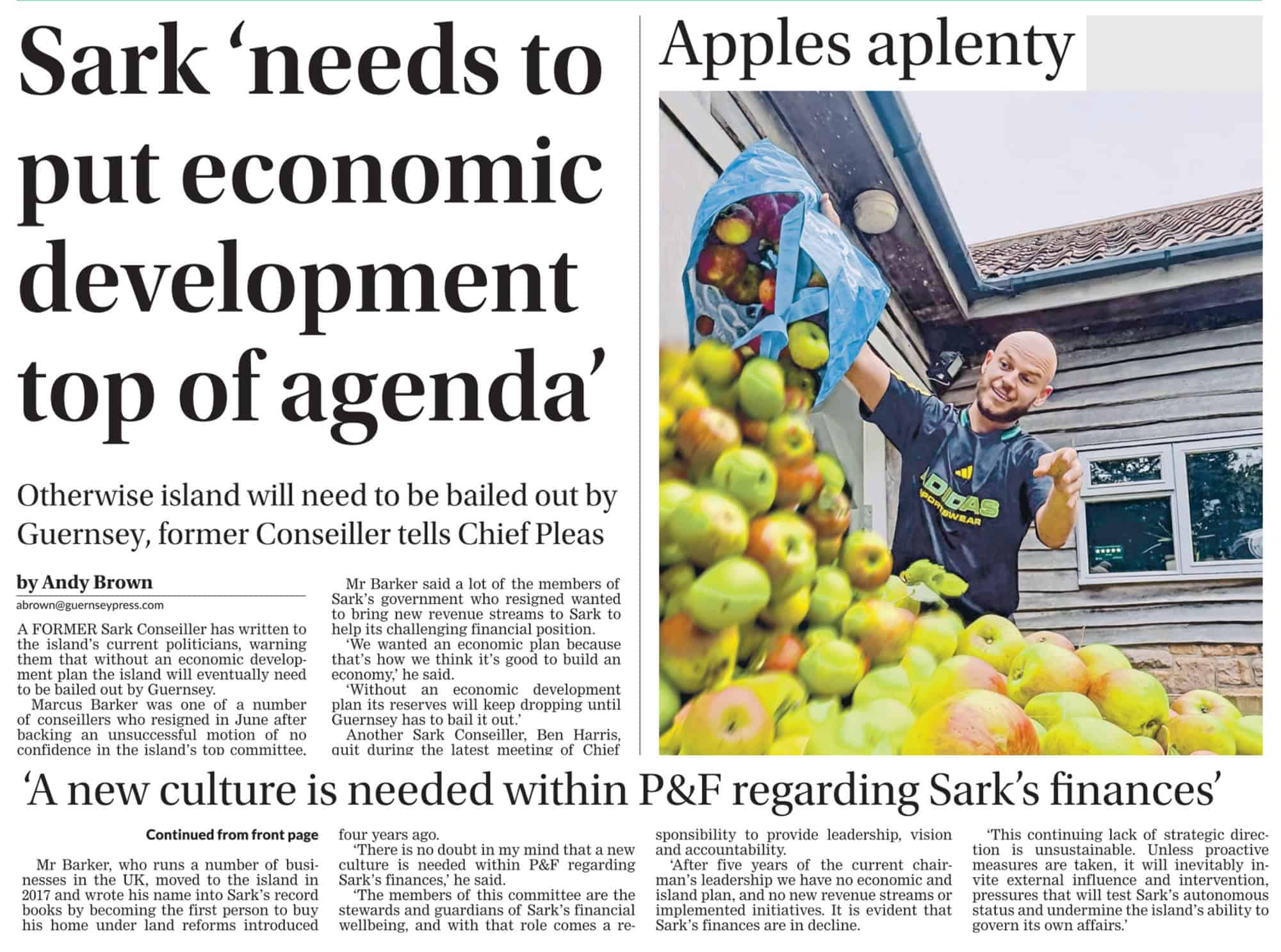
Not everyone agrees. One of the remaining members of parliament publicly disputed these claims in the local media (see article below). Her reference to "residents who live in Sark year-round" was a thinly veiled swipe at those who do not depend on Sark's tiny local economy for their livelihood – the "laptop people", as they are known locally.

Source: Guernsey Press, 15 October 2025.
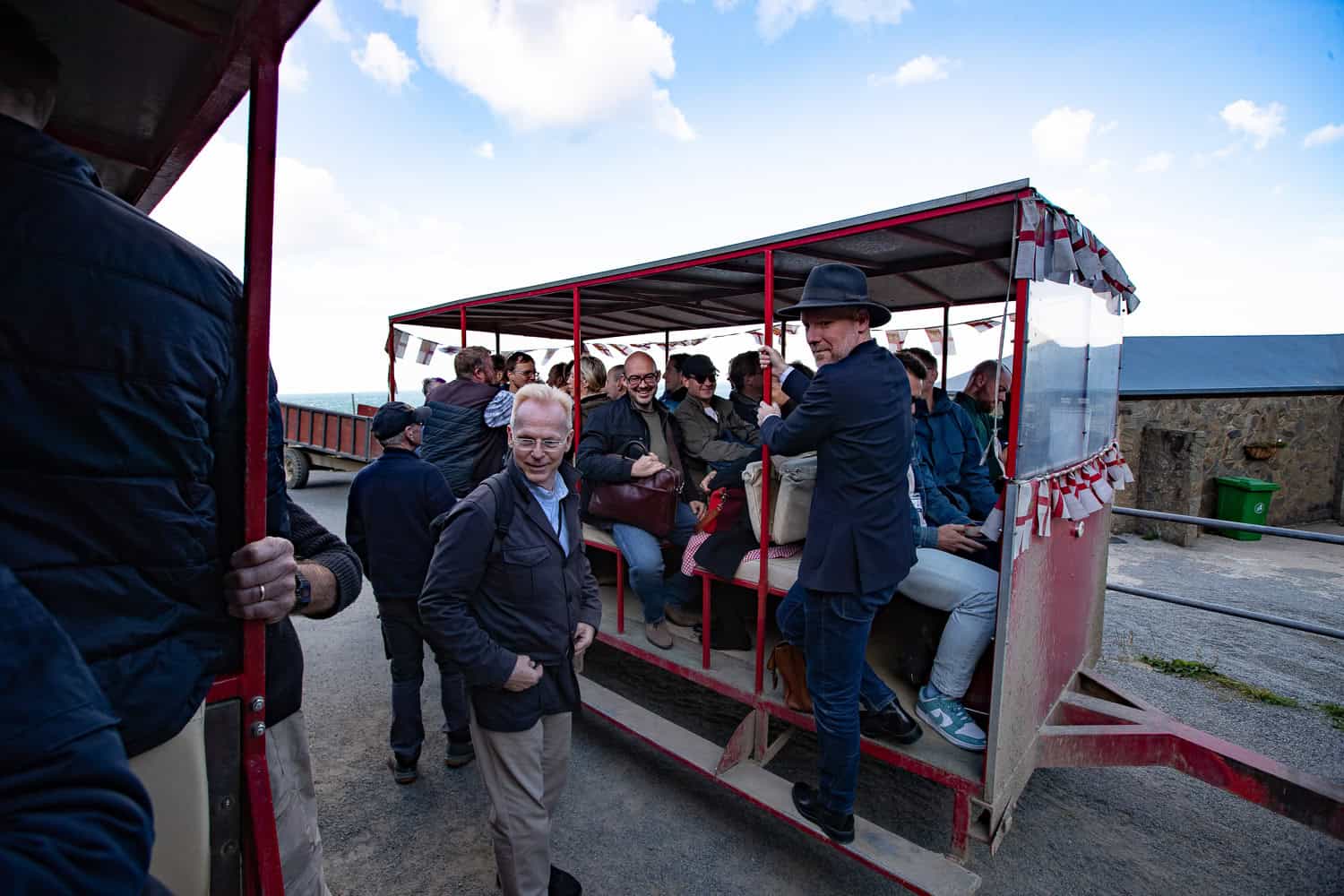
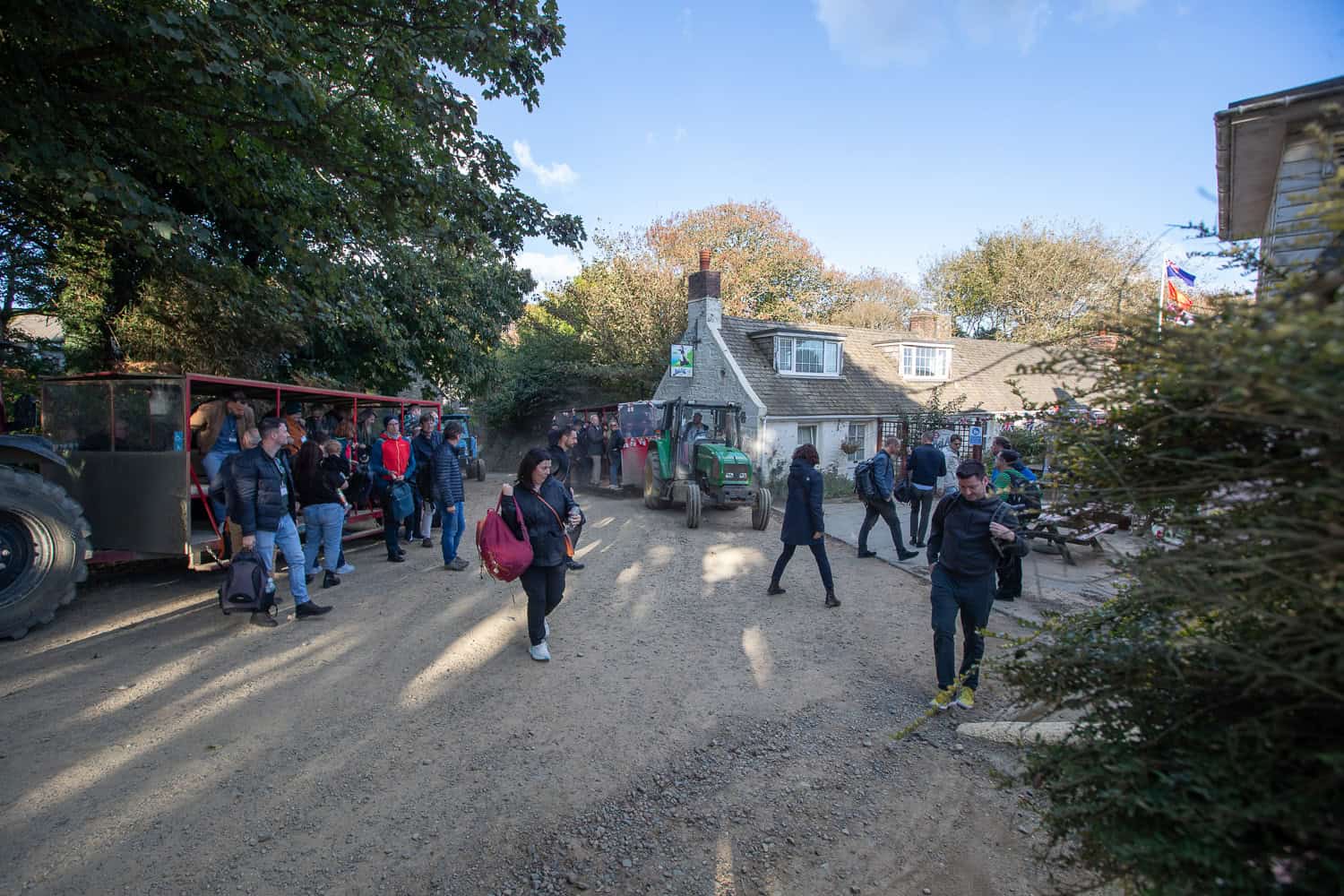
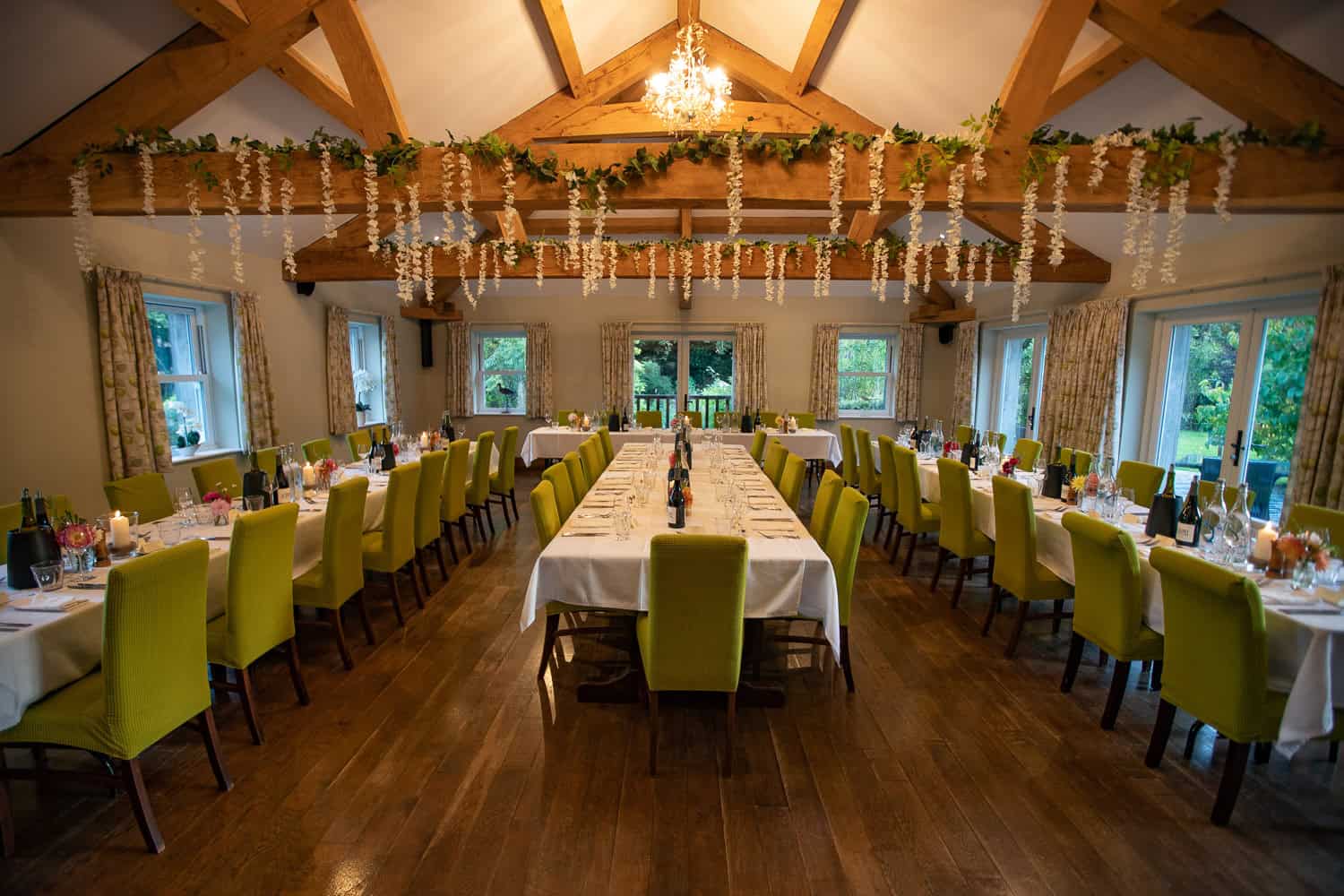
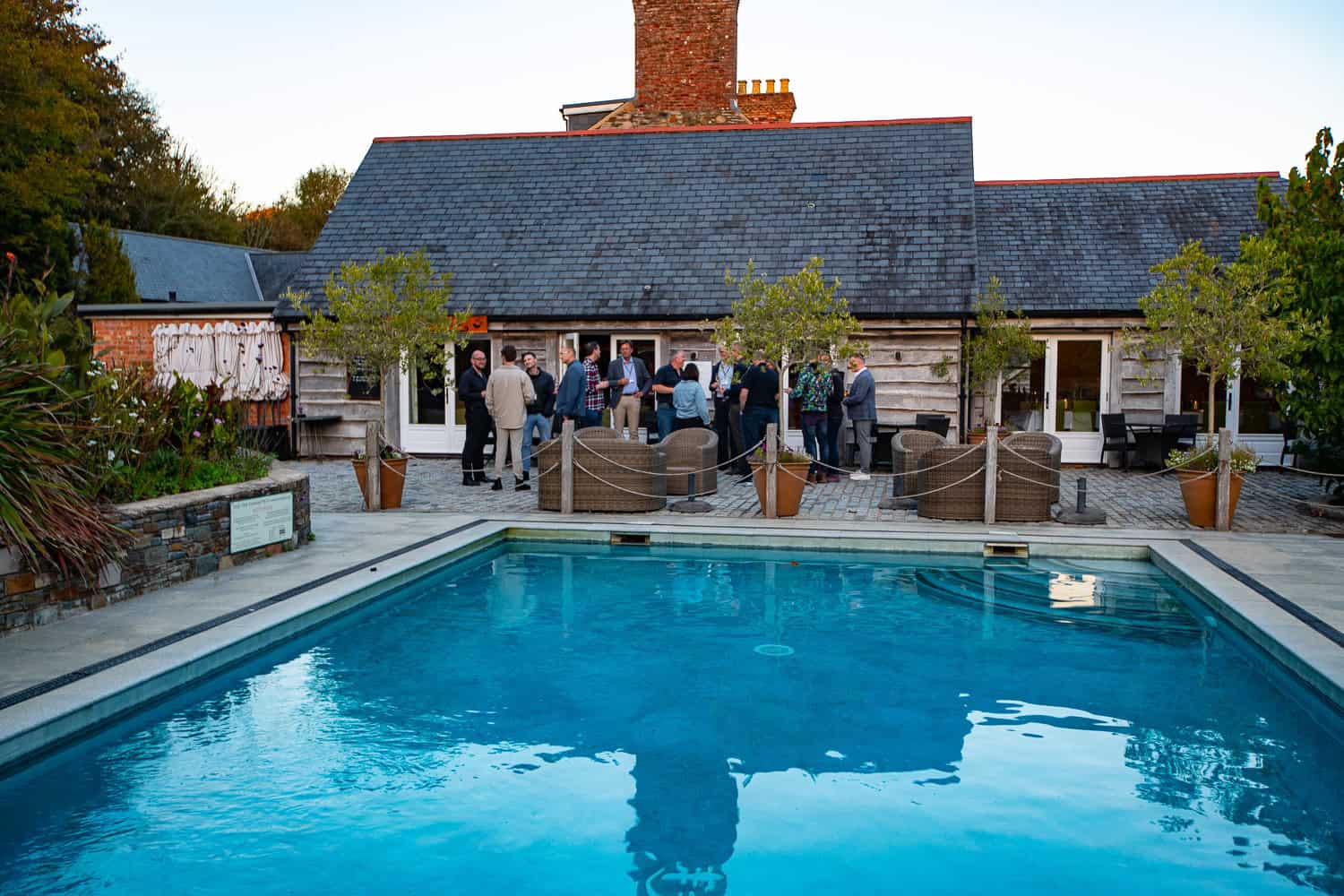
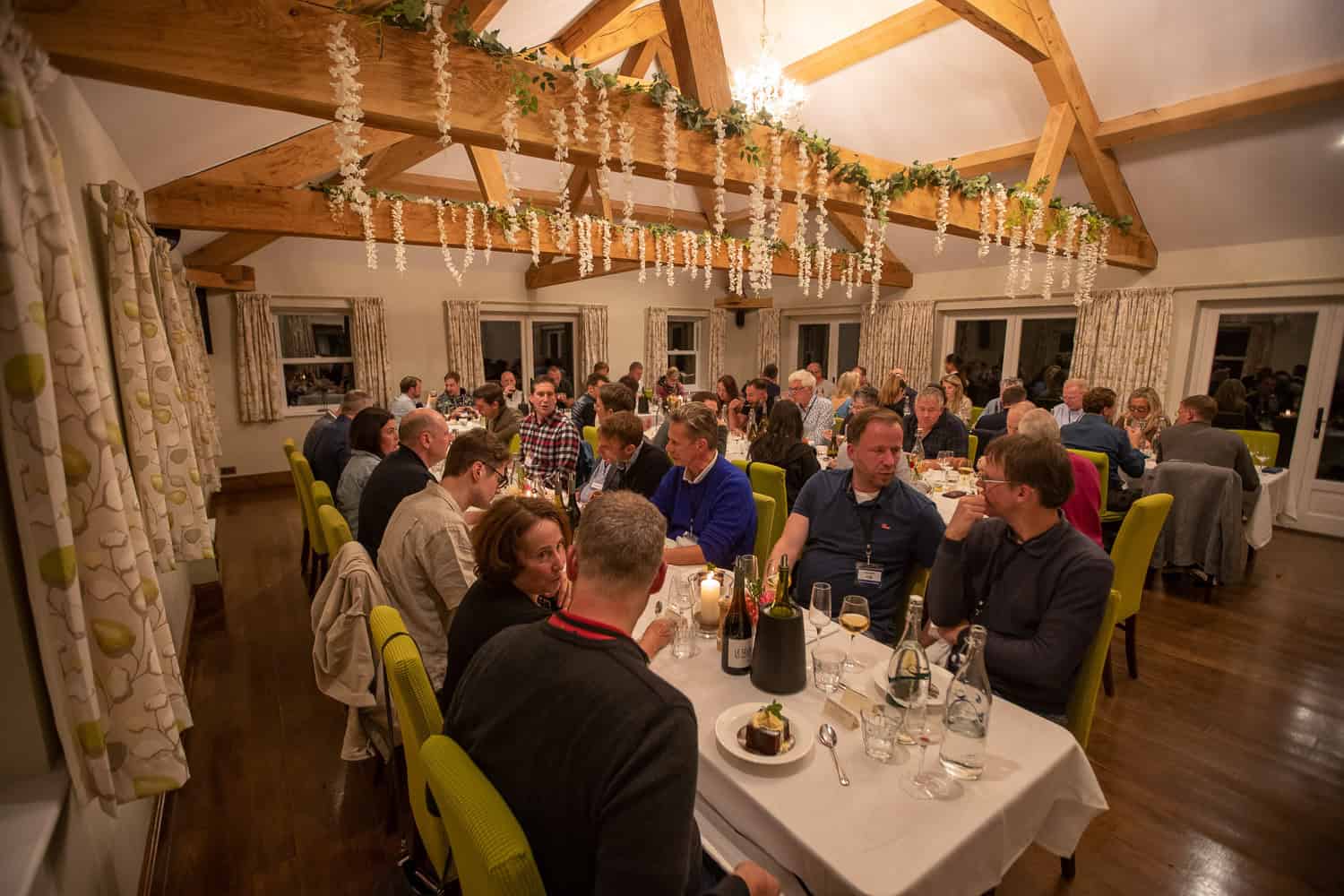
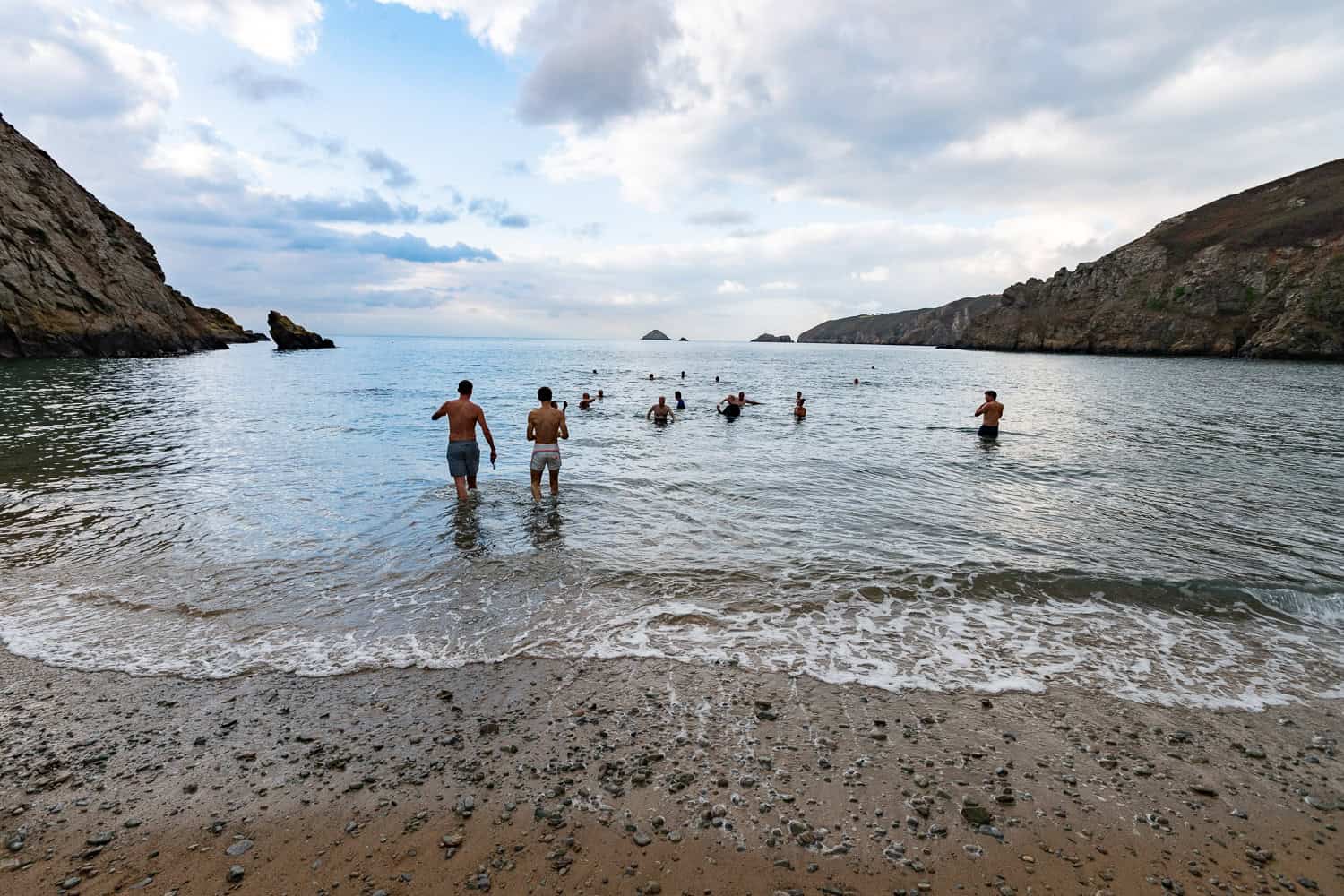
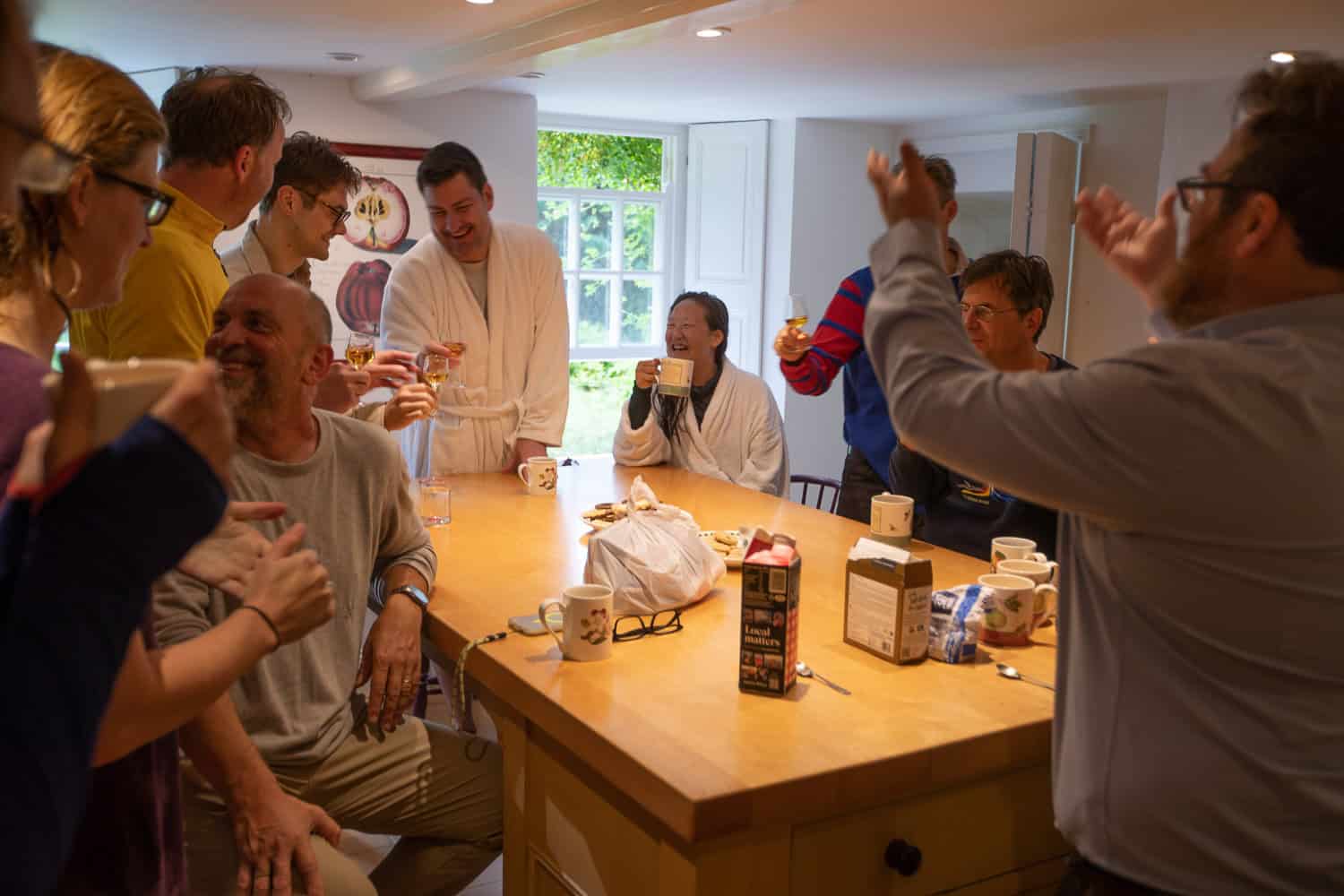
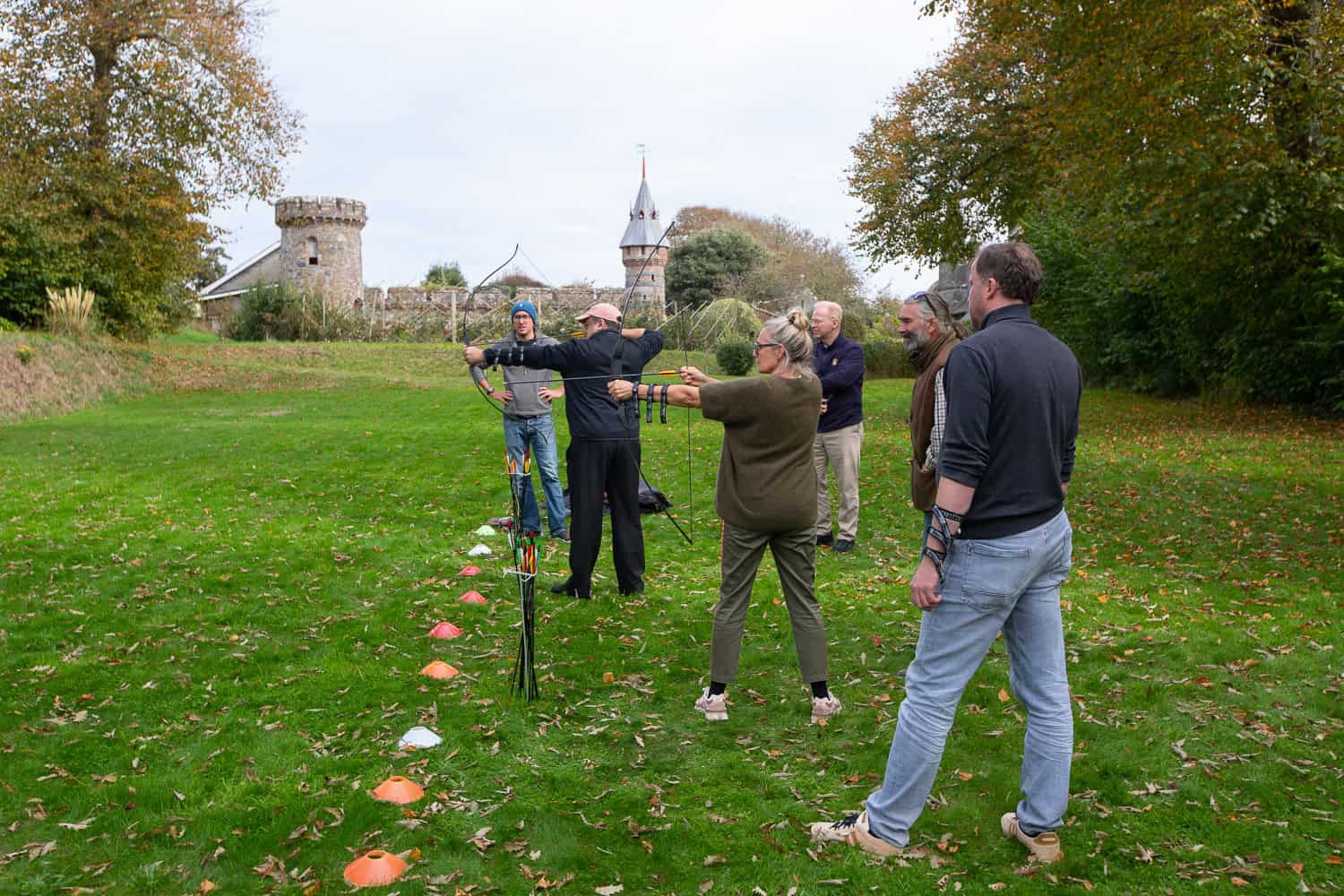
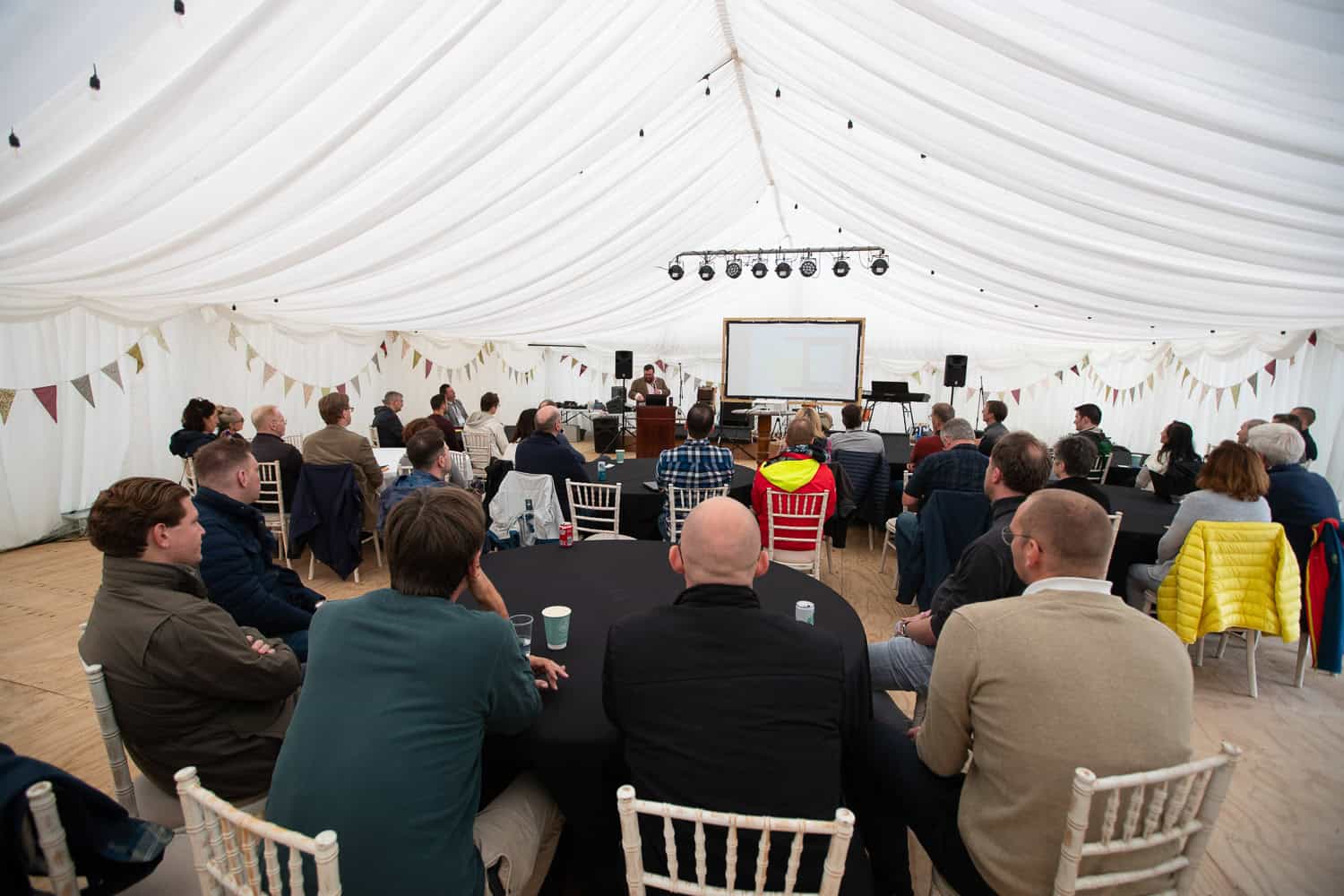
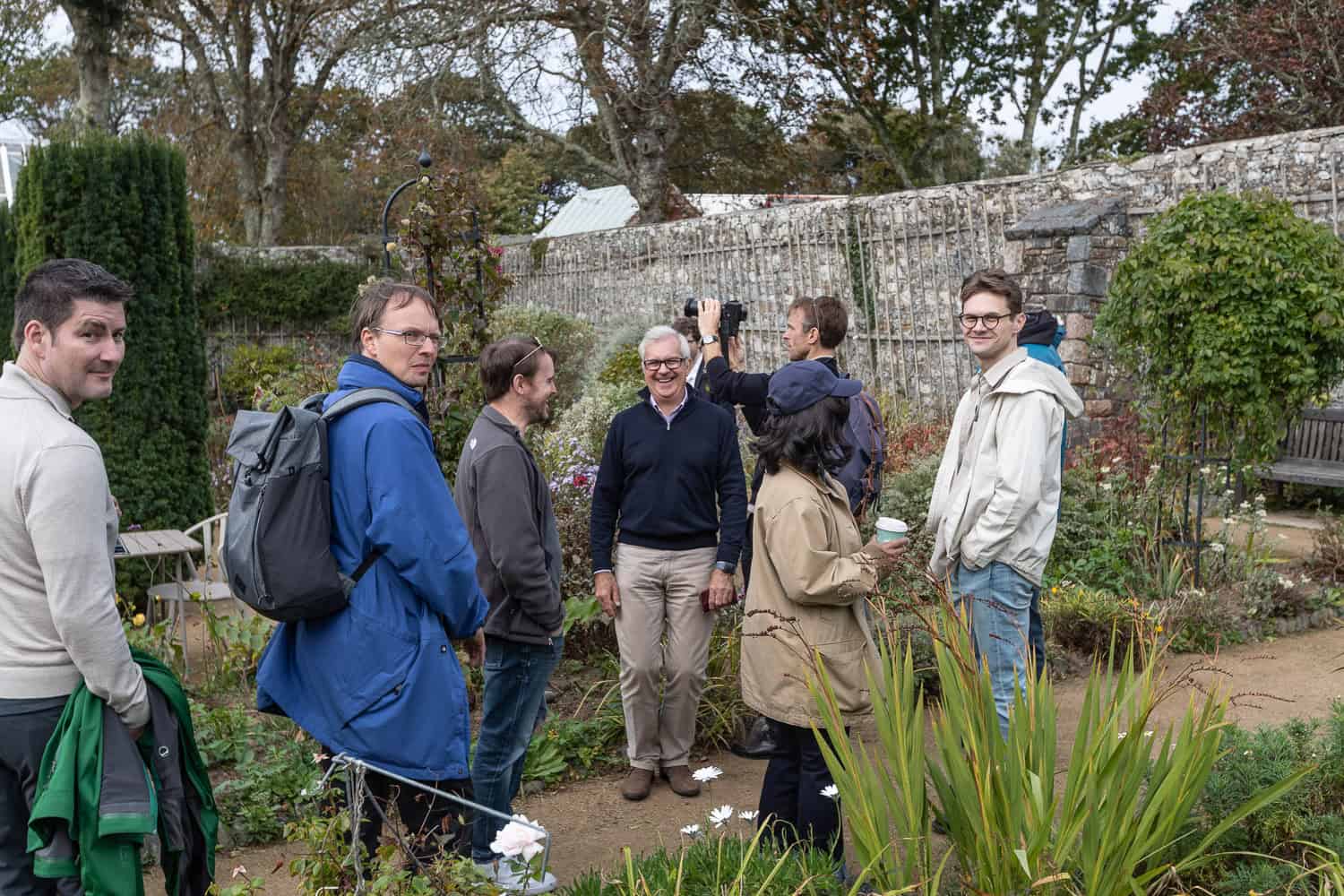
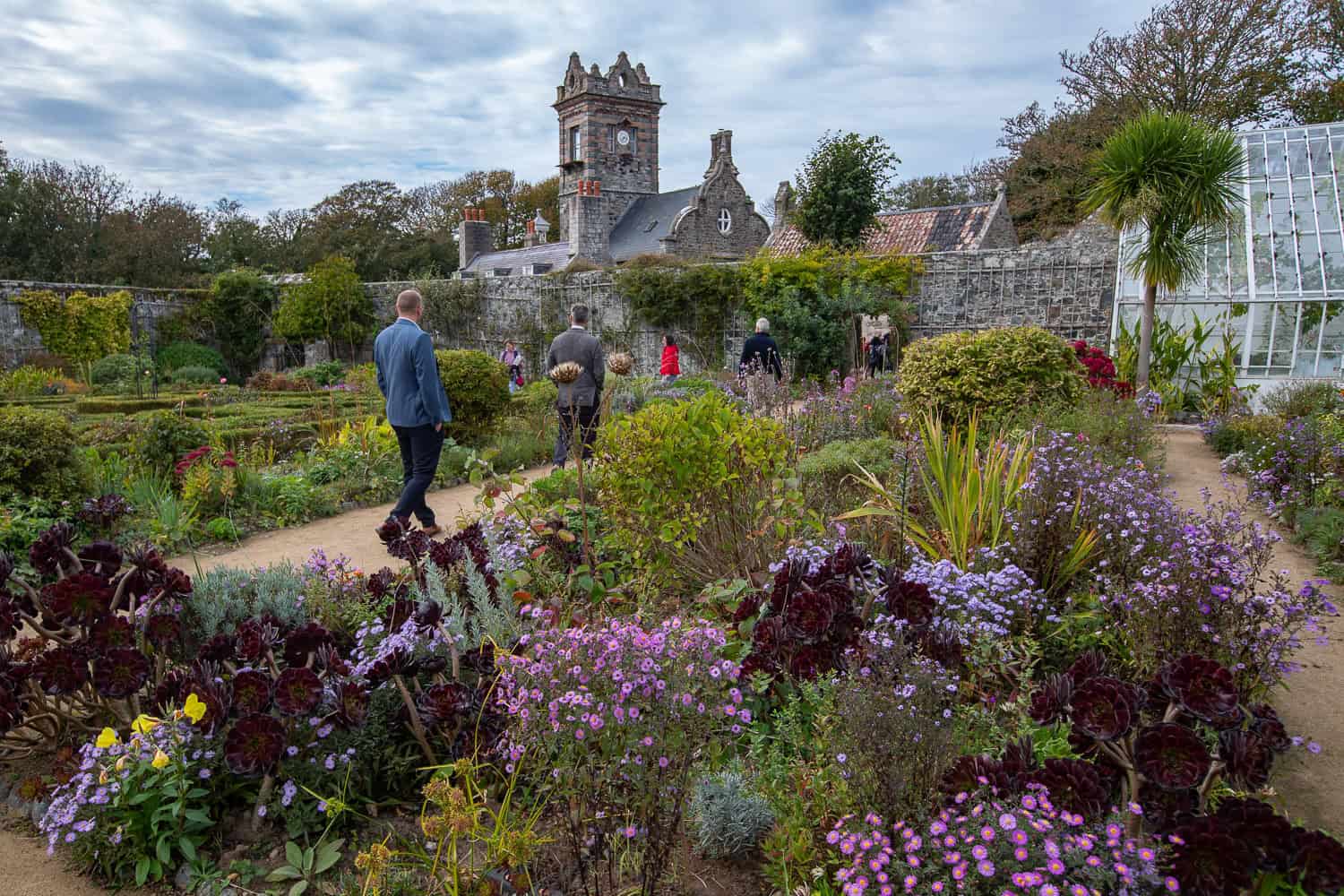
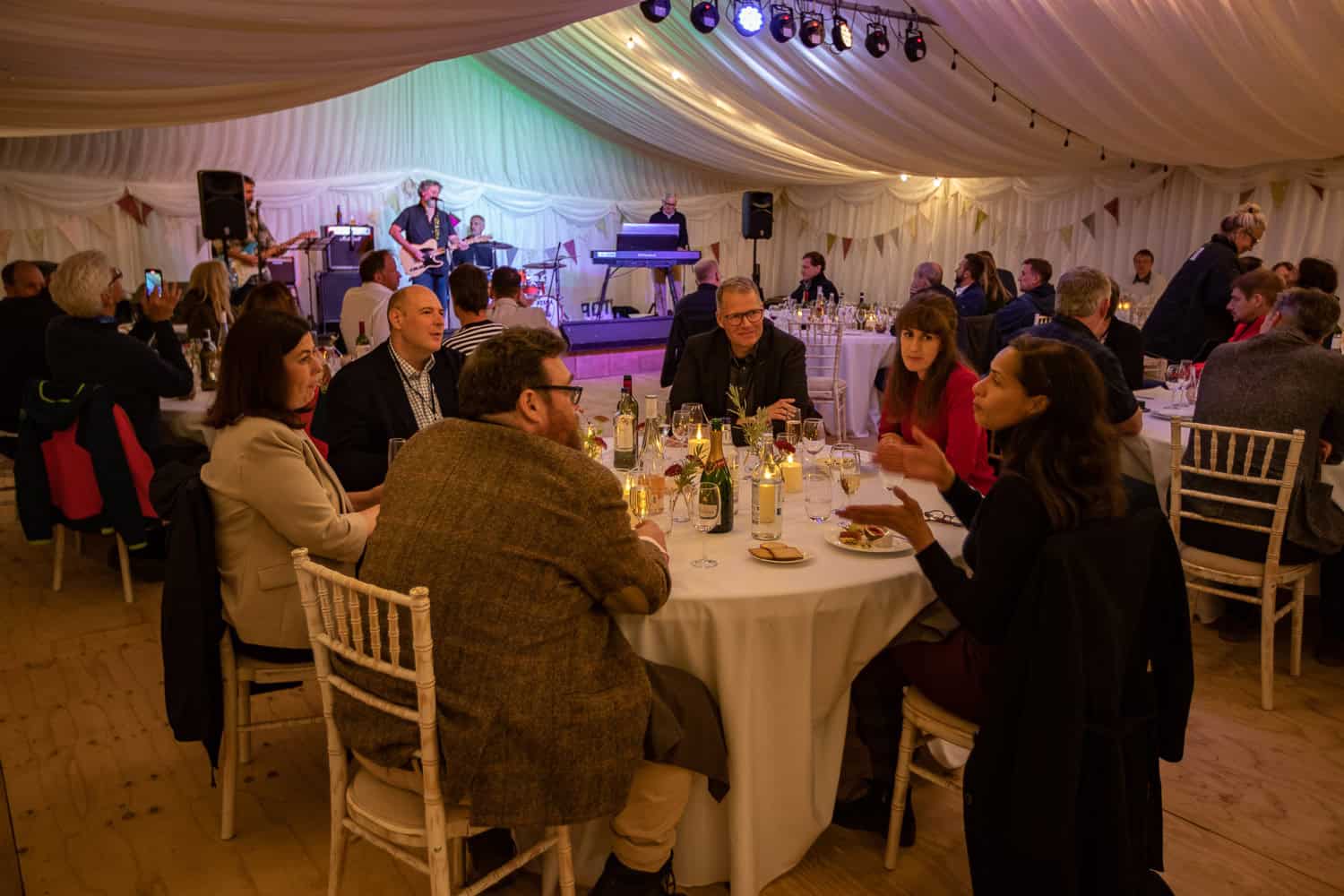
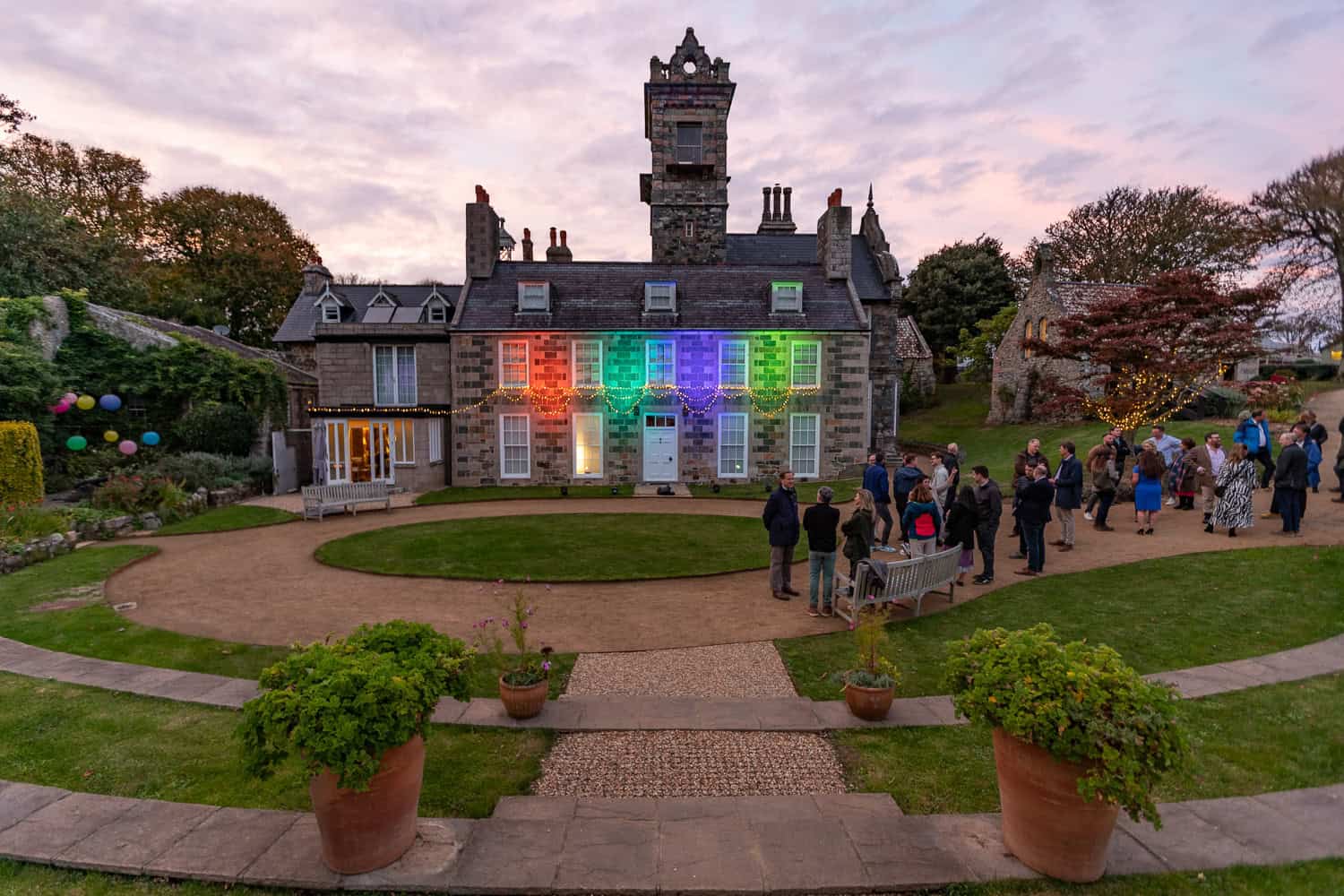
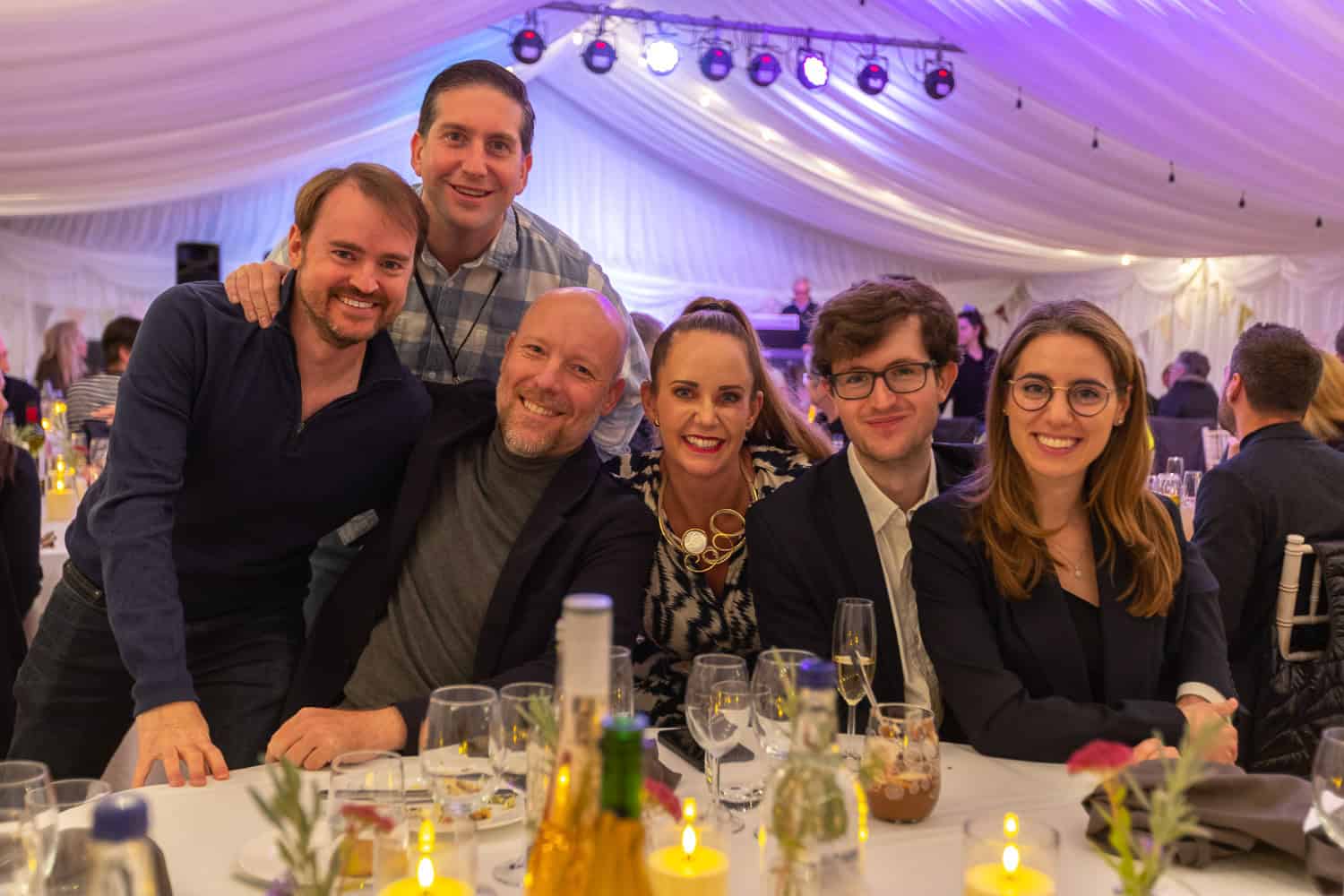
Yours truly – and readers of Undervalued-Shares.com – have likewise found themselves on the receiving end of these skirmishes. In September 2025, 48 readers from around the world visited me in Sark for a weekend of activities, talks, and networking. My group didn't just spend north of GBP 50,000 on local tourist services during low season, but it also donated nearly GBP 10,000 to a local charity.
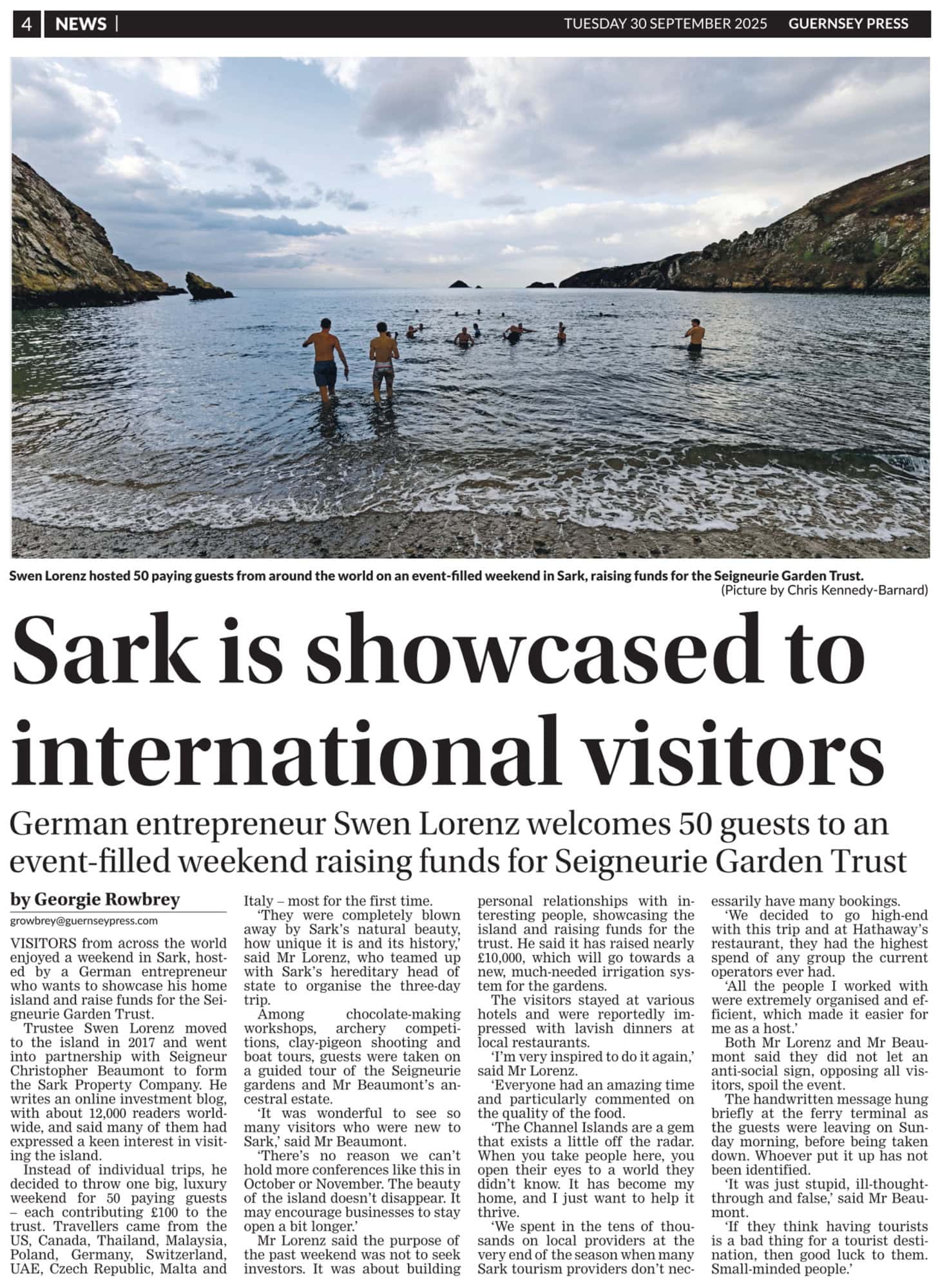
What my group brought to the island didn't spare us from criticism: some Sark residents put up a sign in the harbour denouncing our gathering as a "prostitution of Sark". In the otherwise relatively calm civil society of the Channel Islands, the incident sparked a small storm – enough for me to be interviewed on local television.
It begs the question, is Sark currently a place in which to settle or invest?
It could be a truly wonderful place to visit, live, or build a business. However, for several decades it has, to a significant extent, lived off its glorious past, its stunning natural assets, and its privileged status as a self-governing jurisdiction positioned between the successful and comparatively well-managed islands of Guernsey and Jersey. What Sark has failed to do is actively build a future, strengthen its resilience, and ensure that it remains in control of its own destiny.
I have been saying for years that Sark will only become truly attractive if (or when) the manifold blockages affecting the island are finally resolved. As I wrote in my November 2024 article, under the current circumstances, I would not advise anyone to make long-term commitments to Sark. For years, I have emphasised that I am only renting a house on the island because I lack confidence in its long-term viability and didn't want to be stuck with a stranded asset. In recent times, more than one resident has approached me to say that they now understand why I took this stance.
By now, many readers may be wondering: "Is this entire situation ever going to change for the better?"
The #1 wildcard for developments on Sark is the real estate portfolio held by a trust connected to a member of the Barclay family. This accounts for 20% of the island's land mass and a slightly higher share of its built environment.
The Sark Property Company's offer to purchase this estate for GBP 20m and immediately start a range of measures that would have improved residents' lives was unsuccessful. Since then, I have been following developments only through the media such as Sky News, which on 9 November 2025 reported that creditors seized the Barclay family's biggest asset, online retailer Very Group. Previous attempts to sell the company for GBP 4bn had failed, and the circumstances suggest it is unlikely the family got any meaningful proceeds from the sale, which was triggered by GBP 2.5bn of associated debt. This seizure follows the family's gradual divestment of other prominent assets over the past few years, including London's Ritz Hotel, The Telegraph newspaper, logistics group Yodel, and even their Monaco-based yacht. Along the way, The Sunday Times dropped the family from its annual Rich List because "there was not enough 'robust financial data' to estimate their wealth".

Source: The Times, 2 April 2025.
Following this reporting, I am constantly asked whether we are preparing another offer.
The answer is simple: no, we are not.
It's as straightforward as that.
In 2024, we made an offer we considered fair market value, with a premium of about 15%. While there is never an entirely objective answer to what constitutes fair value, we had our estimate sense-checked by a leading local real estate agent, Savills Guernsey. We cannot see how these assets could possibly have become more valuable since then – especially when taking into account the recent developments in Sark.
That prior bid also taught us how difficult it is to achieve constructive engagement with Sark's government.
The Sark Property Company had funded a successful community workshop, which saw record turn-out and gave us confidence that the majority of the community would be willing to discuss ideas for improving the island for everyone. What we did not get, however, was any constructive input from key members of Sark's parliament. We had even prepared to give a stake in the company to Sark's treasury for free, to help build the island's resilience. Over a 20-year period, this could have allowed the treasury to accumulate reserves in the tens of millions. In fact, our investment plan could have meant residents no longer paying direct taxes, shifting most (or even all) taxation to the existing real estate transfer tax instead. Ultimately, we never even published the documents we had prepared on these possibilities, since it all seemed a lost cause to even offer them to an unresponsive parliamentary leadership.
Much like the rest of Western Europe, Sark appears to be on a path of managed decline. At the current rate, the young people growing up on the island will no longer enjoy the same opportunities that today's retired generation once had.
On Sark, this visible decline has reached a point where a growing number of residents are questioning whether the island will even remain independent. Sark's government requesting a loan from Guernsey is seen by some as a first step toward the political and financial struggles that could eventually threaten the island's autonomy. Sark risks becoming another financial black hole for Guernsey taxpayers – as if supporting the formerly independent island of Alderney wasn't already enough of a burden for the neighbouring island's residents.
These are, of course, my personal views and concerns. Many will strongly disagree, which is perfectly fair. As a foreign national who merely rents a house in Sark, earns his living internationally, and travels frequently for work, I do not claim to follow day-to-day developments in Sark. For the most reliable and insightful reporting, I always recommend subscribing to the excellent Guernsey Press.
However, one thing I am 100% convinced of: Sark will not be able to work its way out of its current situation through incremental steps. Either a large-scale solution addressing multiple issues is implemented at once, or the island will simply remain stuck.
At this stage, I believe this challenging situation can realistically only be addressed by the landowners.
In 2008, pressure from the Barclay family prompted Sark to transition from a feudal system dominated by multi-generational landowner families to a democracy. They believed this change would better serve their long-term goals.
Somewhat ironically, the legal challenges initiated by the island's formerly richest family have – in just 17 years – contributed to a parliament that many now describe as distinctively focused on the slogan "Tax the Rich".
So, what will Sark's landowners do about the situation – if anything?
Even though Sark is now governed by elected politicians, the landowners could still pull the strings if they organised and leveraged their economic power.
Will they, or won't they?
For now, my bet is on a group of Sark's landowners launching a half-hearted effort that quickly fizzles out. Many are simply too old, too worn down by the ongoing situation, live abroad, or lack the expertise to make anything happen. I'd be surprised if the island's landowners could organise themselves effectively.
Earlier this year, one significant Sark landowner reportedly approached banks in Guernsey to borrow GBP 1m, secured against an entire portfolio of real estate. If my intel is correct, he was turned down everywhere.
If true, this anecdote illustrates the state of affairs perfectly. It's become abundantly clear that Sark's future is uncertain. Raising money against a Sark real estate portfolio has become a high hurdle, even if the prospective lender is asking for a very low loan-to-value ratio.
Sark has effectively tied itself into a spaghetti ball of problems. At this point, mere further stagnation would arguably count as a success. More likely, however, it'll be yet more decline. Meanwhile, Sark's politicians will probably keep the island trapped in a forever-loop of producing papers and plans, hiring consultants, and seeking expensive legal advice – with little to show for it at the end.
Call me sour grapes, but the evidence is just not looking promising. Check out the following reader letter published by the Guernsey Press.

Source: Guernsey Press, 12 November 2025.
As revealed in my November 2024 article, if I had to have a second go at bidding for a large commercial opportunity in Sark, I'd do it very differently.
Back then, I offered my own work on the cheap to manage media criticism about "You only want to make money off Sark". If I ever got involved again, I'd do the opposite. My involvement would come at a premium. Frankly, that's how it should be for anyone who agrees to step into this hot mess. Anyone taking on a larger, prominent investment in Sark has to accept that it's a career-defining risk. Given how small any project in Sark will be financially, it's difficult to see any serious player taking on that risk.
Besides, my life has changed since then.
The success of raising money for a near-impossible situation and the media attention it generated has brought a number of other opportunities my way. I have been approached about one project where a capital partner would back me with ten times what I raised for Sark. Separately, if I can find the time, I might pursue a similar opportunity elsewhere, with a much larger scale and clued-up landowners. Meanwhile, I am making fast headway launching a real estate fund for Ukraine – ironically, a hot war country has proven easier to plan real estate investments for than Sark. Even though nothing came out of my Sark work financially, being involved was incredibly valuable.
"Thank you, Sark!", I say.
I keep an open mind about Sark. Beyond stagnation and decline, fortunes could suddenly change from a completely different angle. For example, the Barclay family might decide to sell Castle Brecqhou, potentially generating a seven-figure property transfer tax for the Sark treasury. Of course, the castle could also be sold to someone problematic, leaving Sark tossed from the frying pan into the fire. As yet another option, the Barclay family could reorganise successfully and return for round #2 of investing in Sark. Based on public information, it's reasonable to assume the Sark portfolio is well-protected against creditors via a trust structure.
At this stage, it's anyone's guess.
If we ever considered another bid for a large commercial opportunity in Sark, it would probably happen quickly. The 48 guests I hosted in Sark in September 2025 didn't get a pitch about investing in Sark, but this group alone could have funded a second bid before I'd even poured a second cup of coffee at breakfast. Many prior investors have already offered to participate again, or even increase their investment. Raising large amounts of capital for Sark would now be a walk in the park for us.
A decent among of capital, invested in a targeted way, could make many of the problems mentioned above disappear quite quickly and give Sark positive momentum again. Just as in 2024, when I first embarked on this bid, Sark still has an opportunity to rejuvenate and secure a prosperous future – but only if it embraces outside investment and forward-thinking people. As it stands, what some now call "the world's poorest low-tax jurisdiction" has all the hallmarks of a dying star. Potential is nothing without a plan and decisive action.
The irony is, we may simply not want to be involved anymore.
For now, I'll keep enjoying the island for what it is. Despite the hefty hike in my next tax bill, the GBP 7,000 I'll pay for 2026 still compares favourably with other European residence options. The tax comes with the freedom to not report income and no need even to maintain detailed accounts, making the one-page tax return a breeze. With British Airways' new service connecting Guernsey to London-Heathrow, I feel like New York and Hong Kong are now the island's suburbs. Provided Sark doesn't lose its electricity supply, life here remains good for those who choose this lifestyle and structure their affairs accordingly.
For the ongoing stream of enquiries about Sark, here's where things stand:
Potential residents: I no longer offer any help or advice on relocating to Sark, finding property, setting up a business, or obtaining a visa. My e-book on this from 2020/21 is outdated and unavailable since May 2024. Serious enquiries should consult the publicly available resources, such as Sark's government website, Guernsey Legal Resources (for Sark legislation), Guernsey Border Authority (immigration), or professional advisors like KPMG Guernsey (tax) and Carey Olsen (law).
Property investors: interested parties should contact the various estate agents operating in Sark and Guernsey.
Hotel and property developers: I am not currently seeking partnerships with anyone. I am not available to help with research or organising visits.
Come and visit!
Sark's Seigneur, Christopher Beaumont, and I have blocked 10-13 September 2026 for a "Sark Weekend 2026". While the 2025 event was primarily about learning about Sark, the 2026 edition will focus on stock-picking, investment themes, and learning from fellow private investors (with a dash of exploring Sark). If you'd like to be among the first to hear the details, drop me a short email. Spaces will go first to Undervalued-Shares.com Lifetime Members first, followed by those who have already expressed interest in attending.
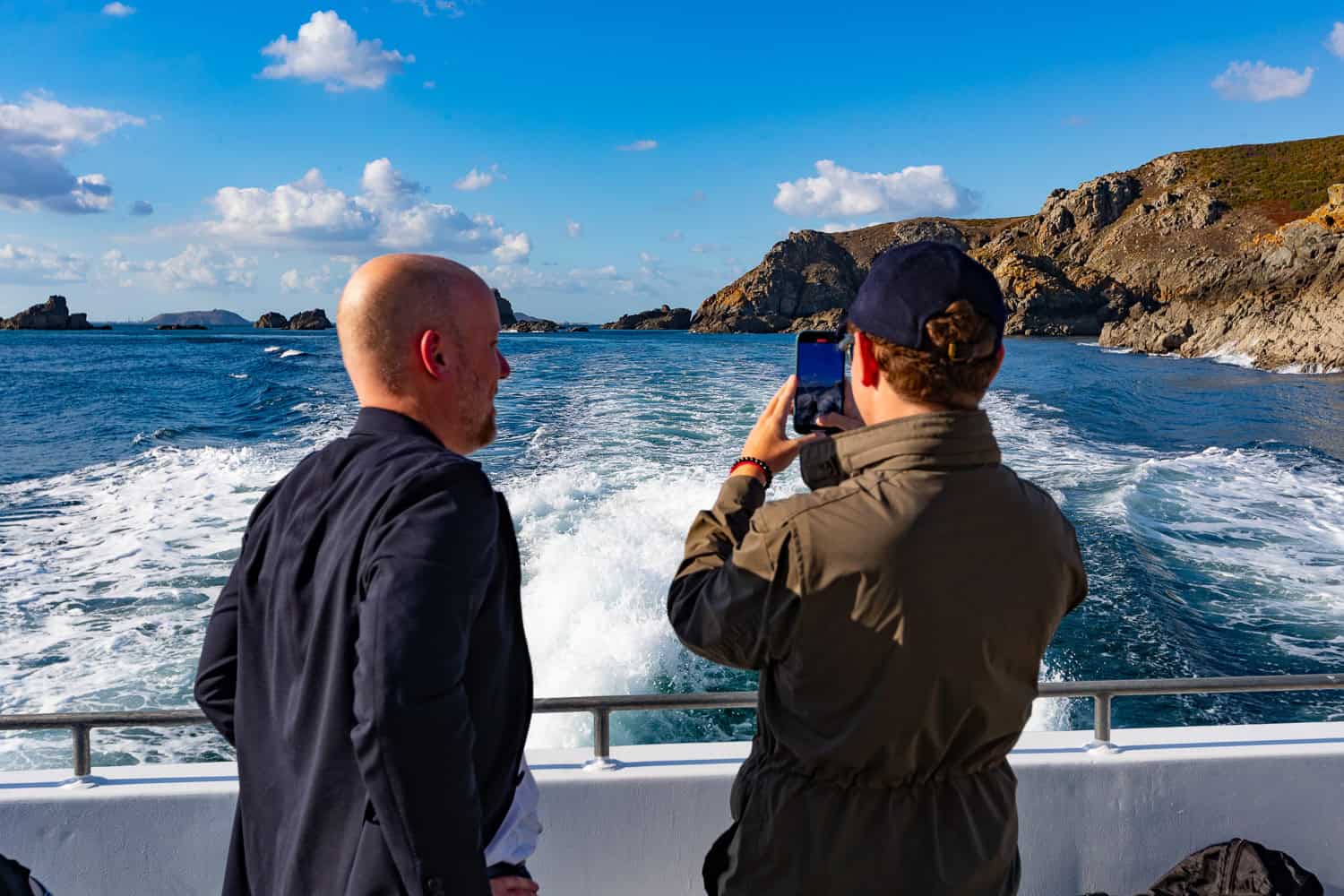
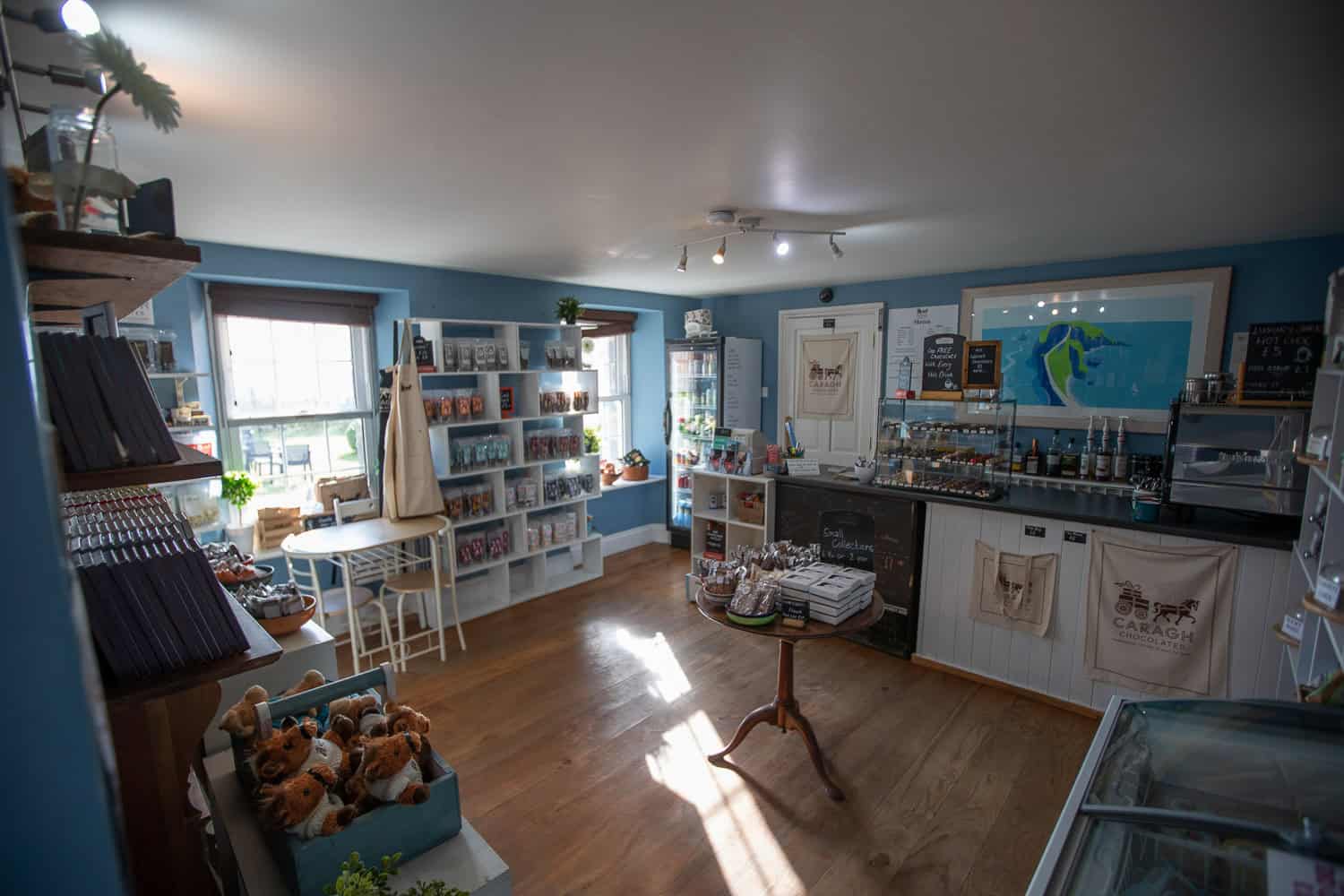
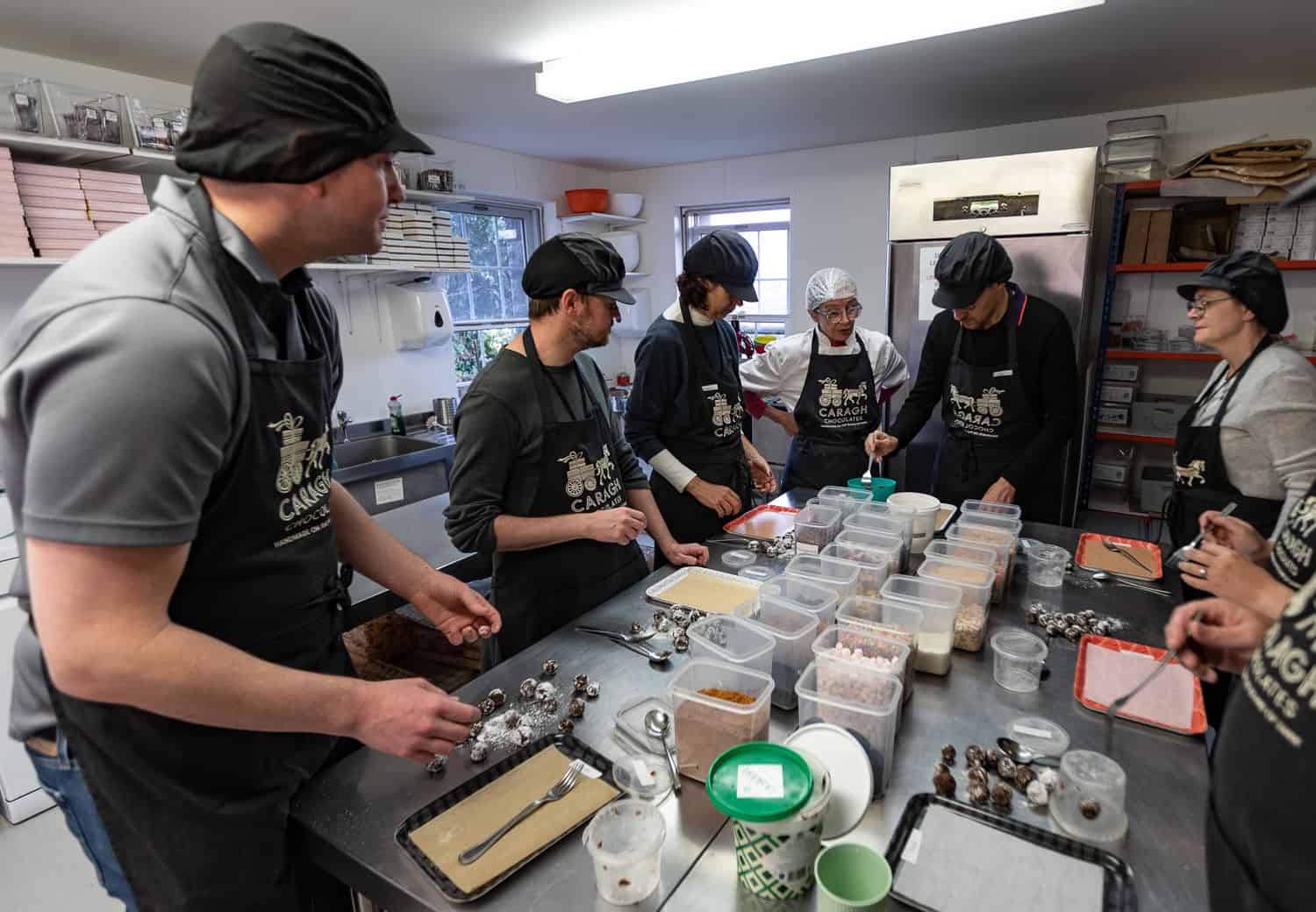
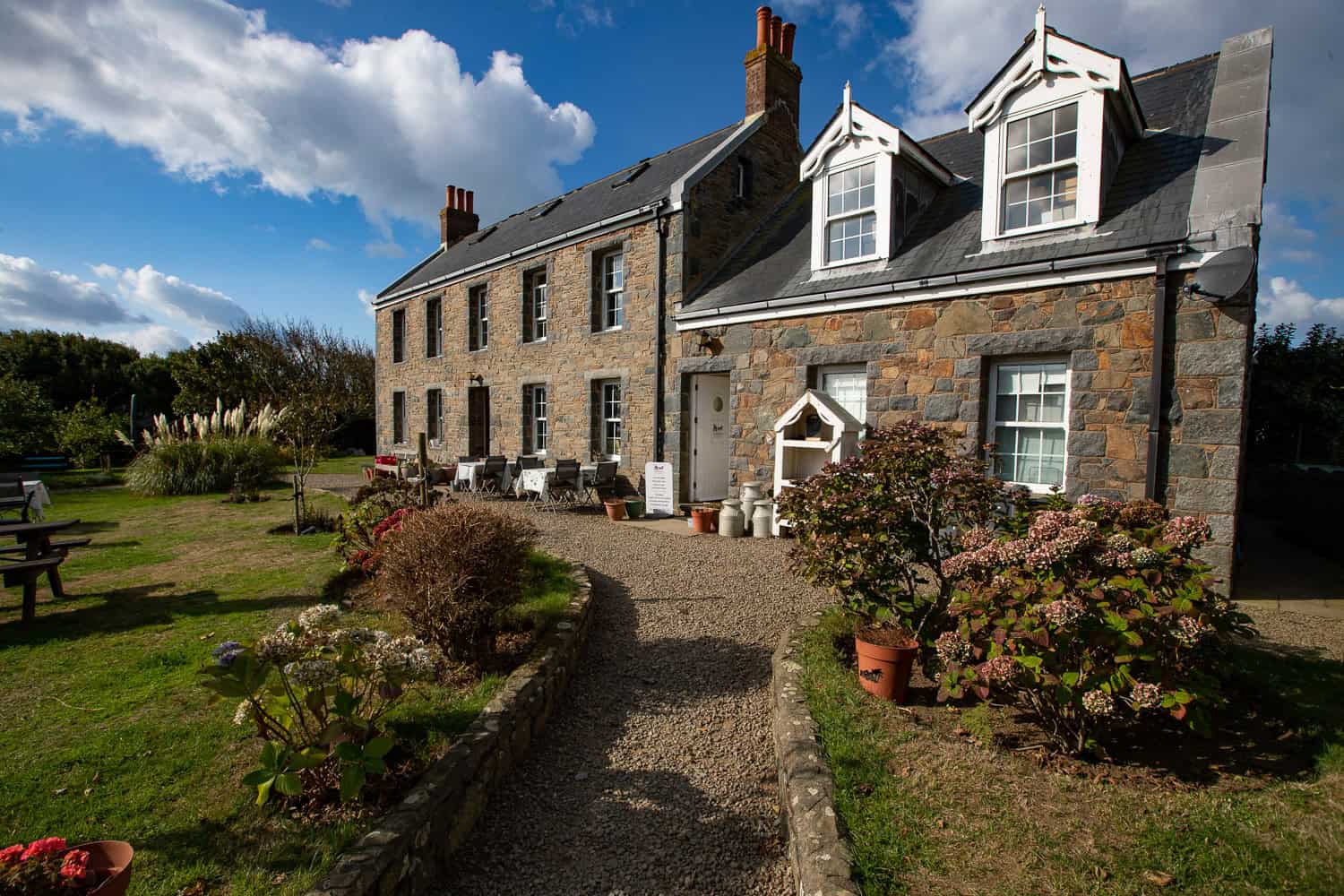
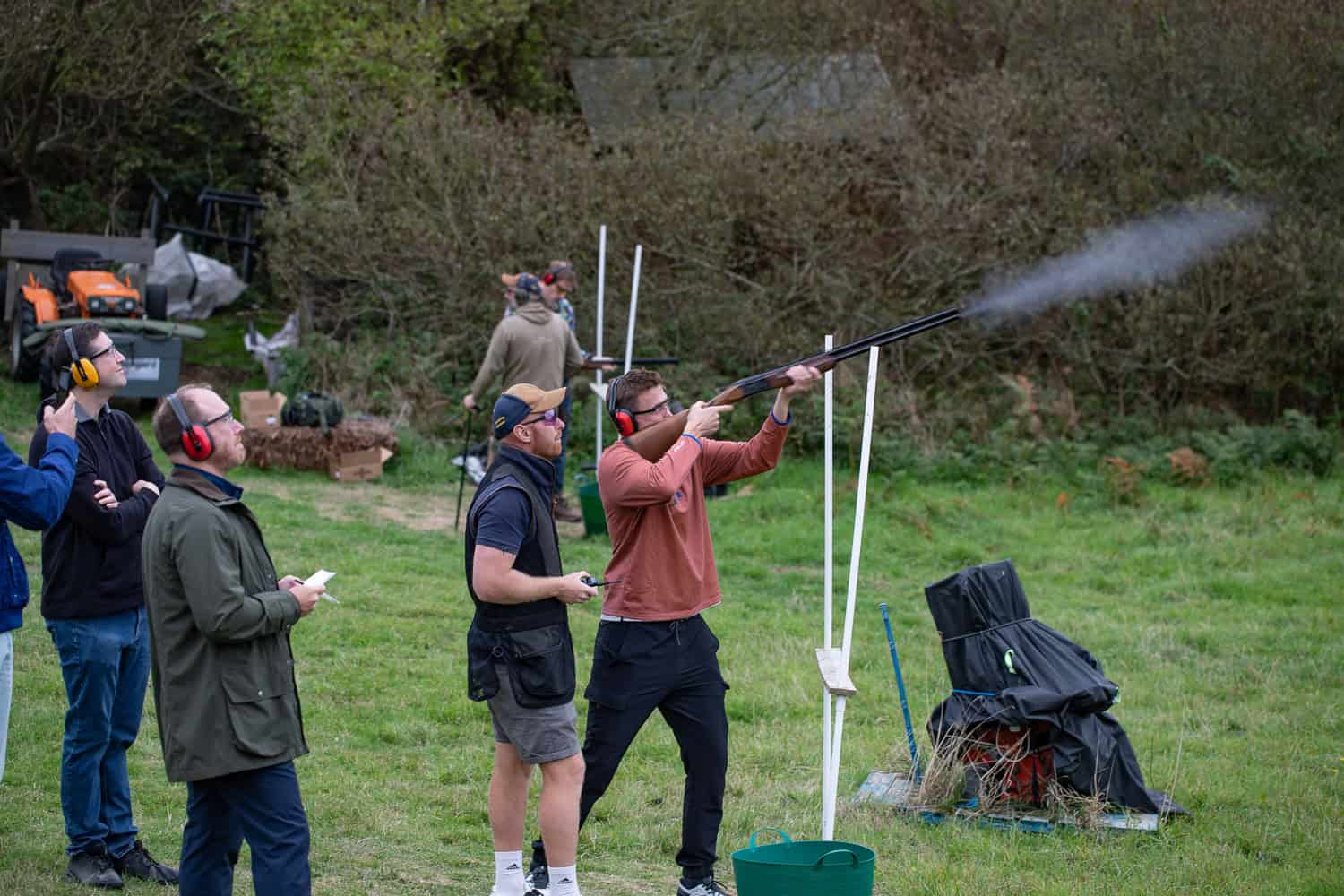
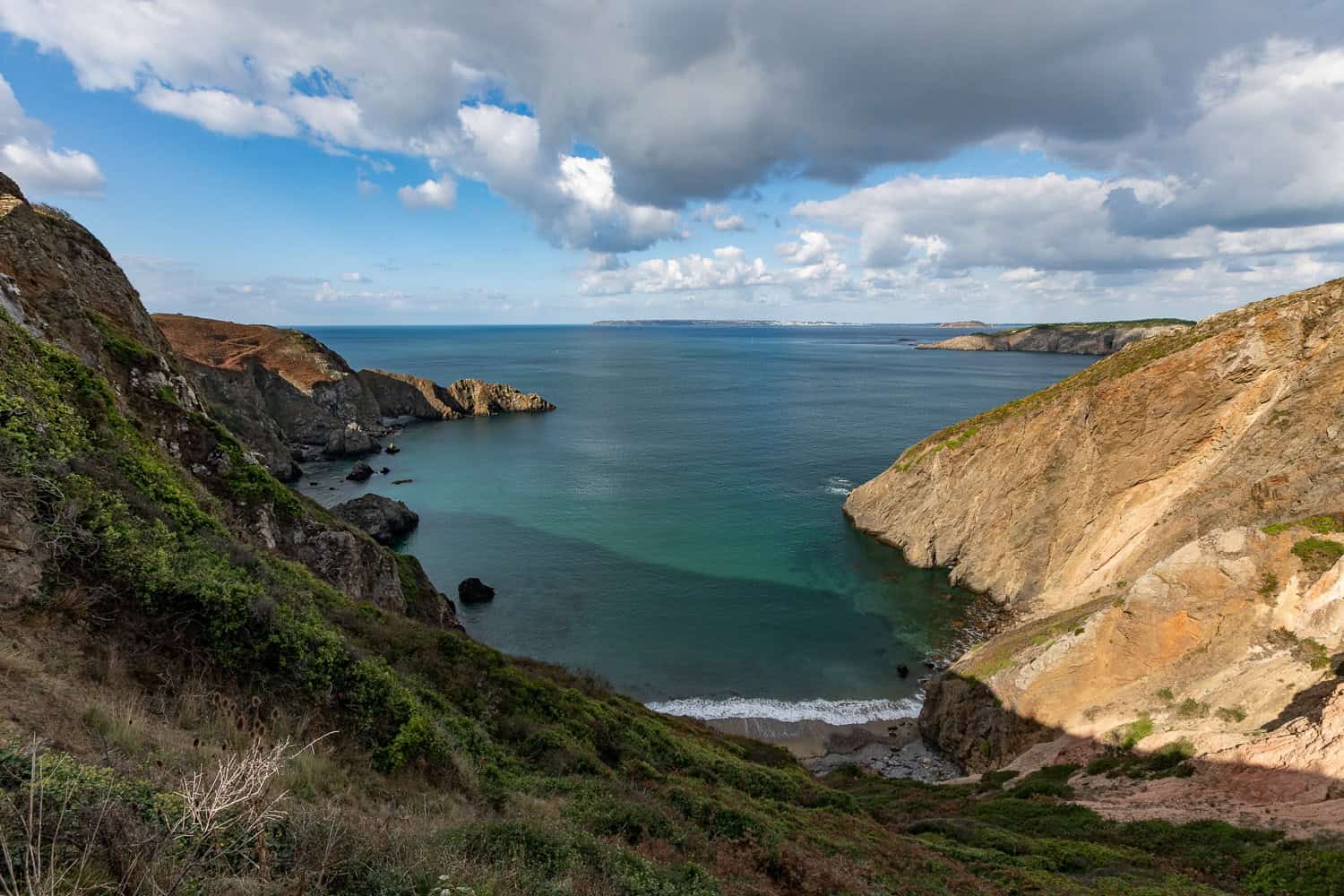
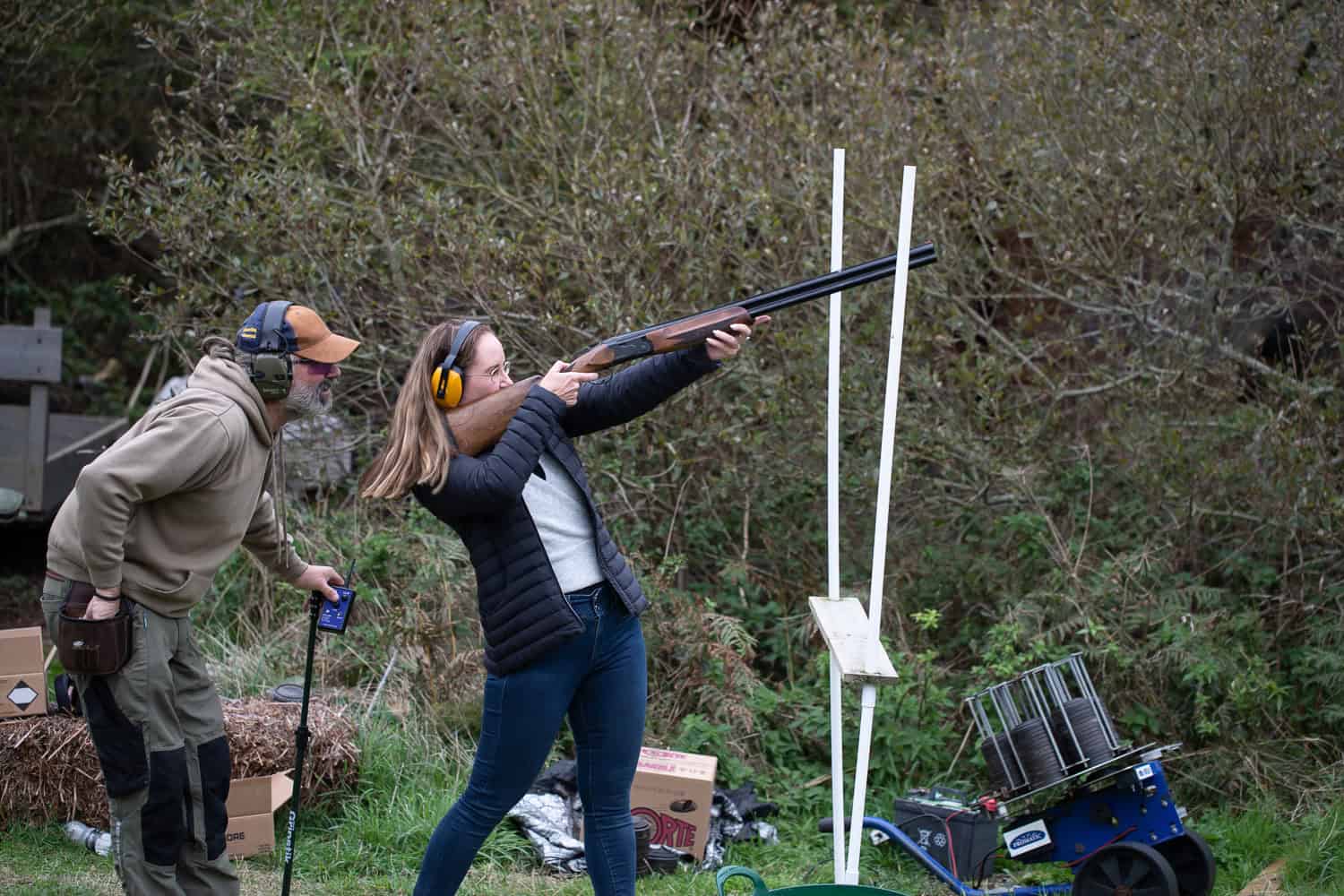
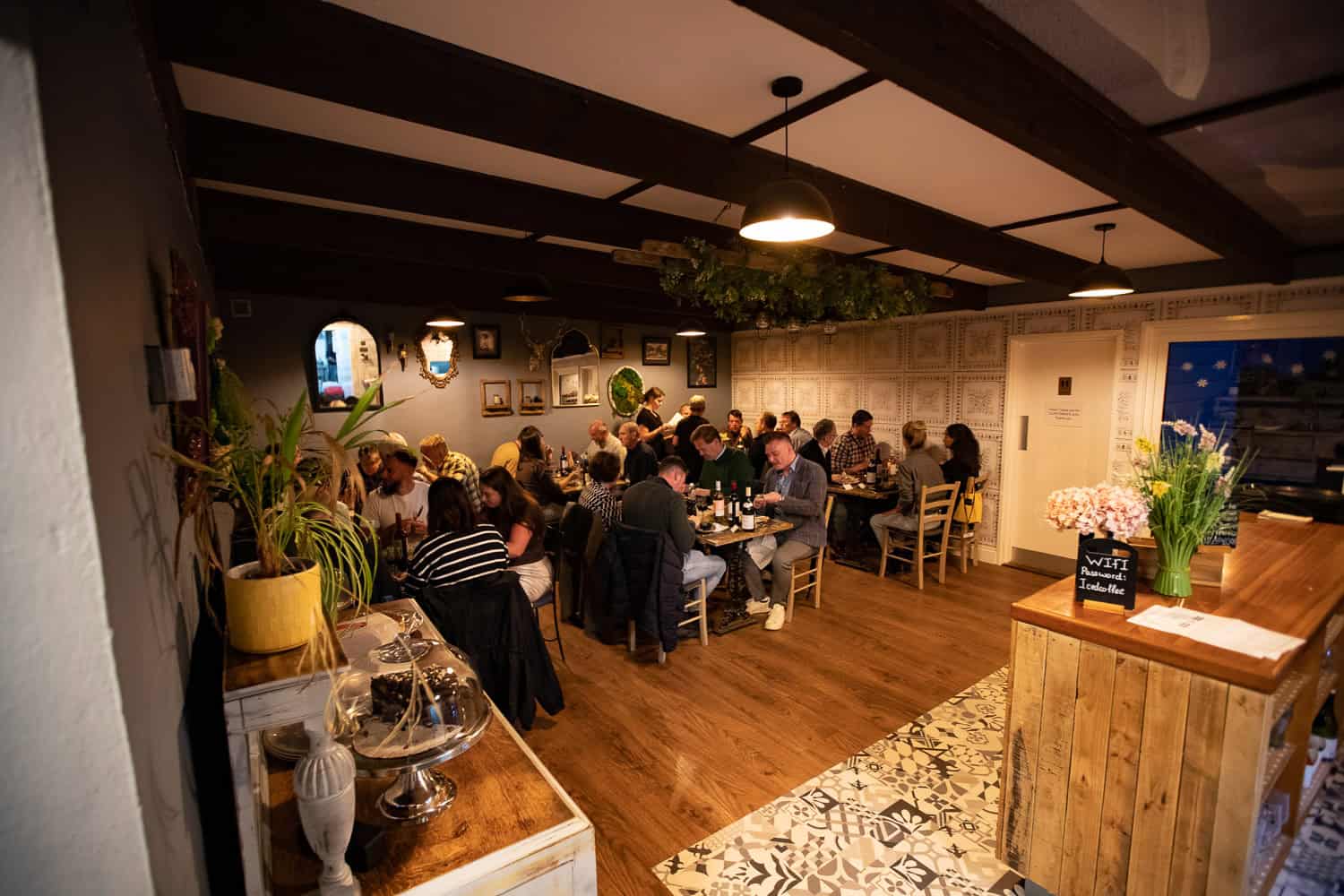
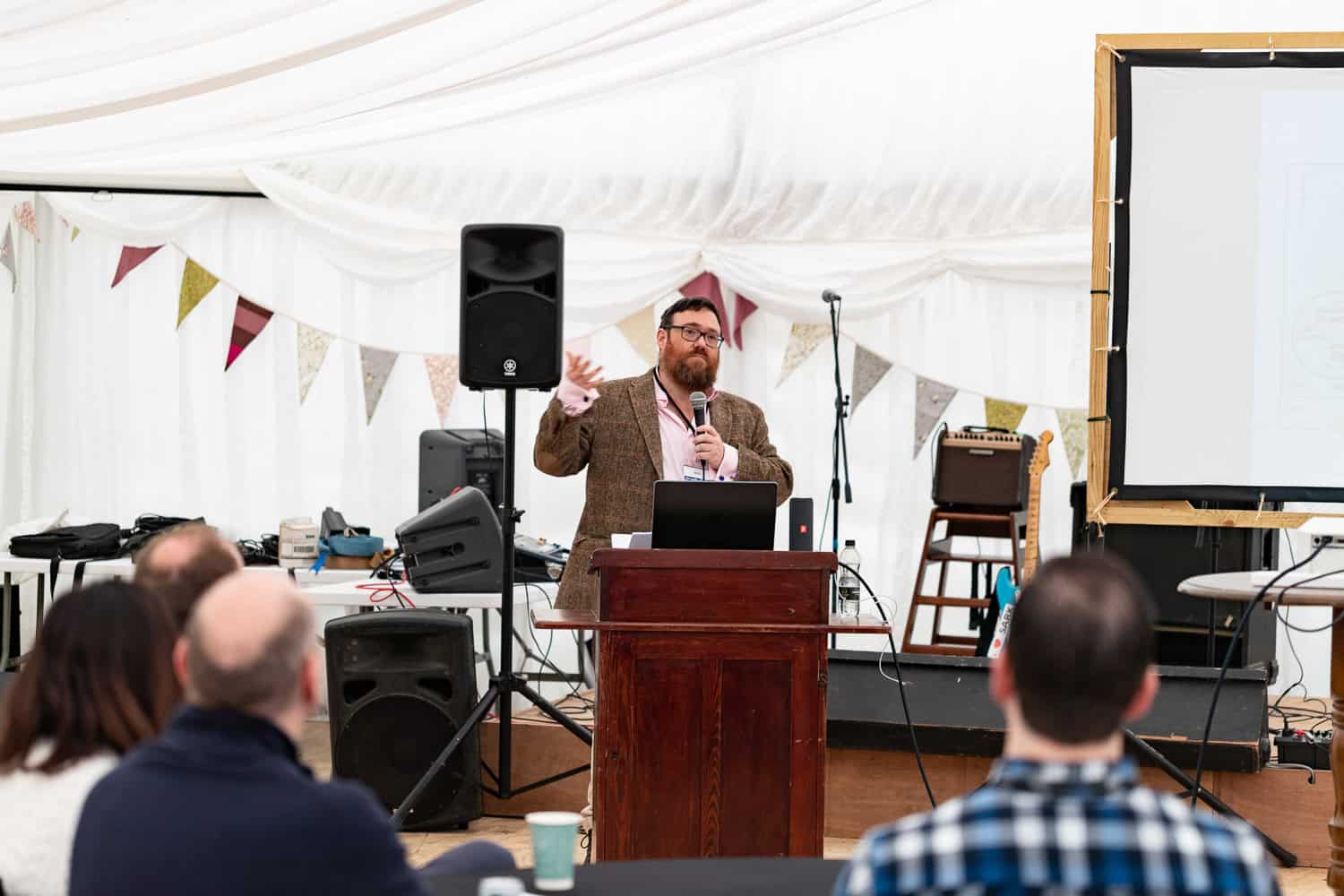
To get a feel for the trip, check the below photo gallery, or this 48-minute video about Sark and the weekend from Ladislas Maurice, aka The Wandering Investor, who was part of this year's group. It's probably the best coverage of Sark in years! Three weeks in, despite the niche subject, 45,000 people have already watched it.
What makes Undervalued-Shares.com stand out from the crowd?
John Newtson, host of the Financial Marketing Summit, and I chat about the challenge of standing out amid "mainstreamed" investment content, the rise of contrarian readerships, and why topics like investing in Ukraine during wartime have struck such a chord.
A revealing talk!
What makes Undervalued-Shares.com stand out from the crowd?
John Newtson, host of the Financial Marketing Summit, and I chat about the challenge of standing out amid "mainstreamed" investment content, the rise of contrarian readerships, and why topics like investing in Ukraine during wartime have struck such a chord.
A revealing talk!
Did you find this article useful and enjoyable? If you want to read my next articles right when they come out, please sign up to my email list.
Share this post:


