The island nation of Cyprus is small but offers a surprisingly diverse selection of listed companies. This includes Bank of Cyprus, Petrolina Holdings, and DCI Advisors.

Cyprus – “weird” opportunities galore
read more

There is a Swiss online bank that I have been a customer of for a quarter of a century.
For many years, I have recommended it to readers who asked me where to open an international brokerage account.
Its stock turned out to be a missed opportunity. Over the past 25 years, it has risen from CHF 1.50 to as high as CHF 570 – well over 300x!
Swissquote is a bank and broker that investors should know about – both as a provider of international brokerage services and as a successful Swiss fintech company.

Swissquote.
I can hardly describe how irked I am never to have written about Swissquote, even though it had been on my list for many years.
As a client since the early 2000s, I was among the firm's first 10,000 customers. Today, the bank has more than 1m customers. From very early on, I had first-hand experience of the quality of the company's services, and that would have enabled me to highlight the underlying investment case.
Over the years, I must have referred hundreds of readers to Swissquote.
The question I typically get is: "My existing broker cannot trade stocks internationally. Where do I go?" Everyone knows of Interactive Brokers Group (ISIN US45841N1072, Nasdaq:IBKR), but far fewer people know about Swissquote Group (ISIN CH0010675863, SWX:SQN), which may be the easier option for many users.
Interactive Brokers is an outstanding brokerage firm, but using its platform properly requires a fair amount of dedication. Swissquote also offers global access to stocks and other securities, but in a more user-friendly format that is likely more suitable for the average investor.
Besides, I have always been a fan of Switzerland as a place for safekeeping assets.
In the 1990s, Swissquote started as a finance portal offering free access to Swiss stock market prices. In 2000, the company went public. The following year, it received a Swiss banking licence.
Initially, this was the brokerage firm you turned to if you wanted to avoid the sky-high trading commissions charged by traditional Swiss private banks. At the time, Swiss banks still charged 0.5-1.2% for stock trades.
Soon afterwards, Swissquote began expanding into ancillary services. I remember getting a credit card through Swissquote at a time when this was a particularly useful tool for foreign clients wanting to access their (untaxed) Swiss wealth abroad without having to carry wads of cash across borders.
Along the way, Swissquote also experienced its share of growing pains. At one point, the company discontinued its credit-card services because of operational challenges associated with offering them. Around the same period, Swiss banking secrecy largely disappeared as far as tax evasion was concerned, removing a major selling point for some foreign clients. Still, I continued recommending the bank because of its flexible approach to client needs and its willingness to have knowledgeable staff members speak directly to clients whenever there was a problem to solve.
For example, residents of the island of Sark (where I live) did not always have an easy time opening international bank accounts. Foreign banks struggled with Sark being a jurisdiction in its own right while not appearing in many online dropdown menus, where it is usually – and incorrectly – subsumed under neighbouring Guernsey. Following a phone call with Swissquote to explain the situation, a fair number of other Sark residents were subsequently onboarded without issue.
Swiss banking as a premium service still exists – even in the age of online banking.
Besides, the stock may also be worth adding to your watchlist.
Given that Swissquote originally started as little more than a website for retrieving stock prices, the company has come a remarkably long way.
At the end of 2025, Swissquote had 1.15m client accounts holding CHF 88.7bn of client assets. The company generated more than CHF 720m of revenue, roughly split half-and-half between transactional and recurring revenues. Pre-tax profit reached CHF 420m.
Why the strong growth in clients?
Over the years, Swissquote significantly expanded its range of services. In 2017, it became the first Swiss bank to offer Bitcoin trading. Today, the platform provides access to 3m financial products globally.
Clients can use their accounts to trade, invest, and bank.
Swissquote offers:
The company has built all this around the idea of becoming a digital-first bank for mass-affluent investors and traders.
Newsweek and Statista have ranked Swissquote among the "World's Most Trustworthy Companies" in financial services, and the firm consistently ranks among the best-known online trading banks in Switzerland. Swissquote has also repeatedly been recognised as one of Switzerland's most innovative banks and fintech firms.
Its capital base is more than twice as strong as required by the Swiss regulator, and the company has had the same CEO – who also remains one of its largest shareholders – for around 25 years.
For anyone looking for an accessible and affordable Swiss online bank and brokerage platform, I will continue to recommend Swissquote as a go-to solution.
The remaining question, though, is whether the stock itself is worth a closer look.
Swissquote appears to have substantial growth opportunities both domestically and internationally.
In Switzerland, Swissquote is a well-known and highly regarded brand, yet the company still only holds a 2.1% market share. Traditional Swiss banks such as Julius Bär and UBS have certain structural advantages, but they also suffer from disadvantages including higher costs and less flexible digital platforms. With its efficient online infrastructure, competitive pricing and accessible platform, Swissquote should be able to continue winning market share domestically.
The company is also targeting younger generations. Five years ago, Swissquote teamed up with Switzerland's postal bank, PostFinance, to launch the finance app Yuh. The app is aimed at younger and less affluent users seeking money management, payments, savings and investment services. A specialised version is even available for teenagers.
The idea is that Yuh attracts younger clients who later upgrade to Swissquote accounts once they become more affluent.
Internationally, Swissquote may benefit from similar structural trends combined with a desire for financial safety during a period of geopolitical and domestic uncertainty. Swissquote not only holds a banking licence in Switzerland, but also in Luxembourg. When arriving at Luxembourg Airport earlier this week to have lunch with an Undervalued-Shares.com Lifetime Member, I was greeted by prominent Swissquote.lu advertisements. In 2024, Swissquote Bank Europe was named "Luxembourg Bank of the Year" by The Banker.

In Luxembourg earlier this week.
Currently, 67% of the firm's client assets originate from Switzerland-based clients. As a global investment platform operating out of both Switzerland and Luxembourg – arguably Europe's two premier banking safe havens – Swissquote should be well-positioned to continue attracting international clients.
At the same time, competition is also increasing.
J. Safra Sarasin, the 180-year-old Swiss private bank, recently acquired a 70% stake in Saxo Bank, the Danish investment bank often described as Europe's answer to Interactive Brokers. The deal is somewhat reminiscent of Morgan Stanley's acquisition of E*TRADE in 2020, which gave the US investment bank access to 5m retail clients. Swissquote is clearly no longer alone in promoting competitively priced online brokerage services.
At the same time, fintech firms such as Revolut, N26 and Wise Group (ISIN JE00BQKY0816, UK:WISE / Nasdaq:WSE) continue expanding internationally. Inevitably, these firms will increasingly compete in Swissquote's home markets and become formidable rivals for internationally minded clients.
All of these companies are competing for "Henry 2.0" clients – "High Earners Not Rich Yet" – digitally savvy and relatively affluent customers seeking to combine traditional financial services with access to alternative investments such as crypto and venture capital. This intensifying competition could eventually weigh on Swissquote's margins.
For now, Swissquote projects that it will generate CHF 950m of net revenues and CHF 500m of pre-tax profit by 2028. Along the way, management intends to use AI as "a force multiplier for client empowerment, scalability, and operational leverage". There could also eventually be leadership changes, as the founder and longstanding CEO has reportedly been considering retirement as early as 2027.
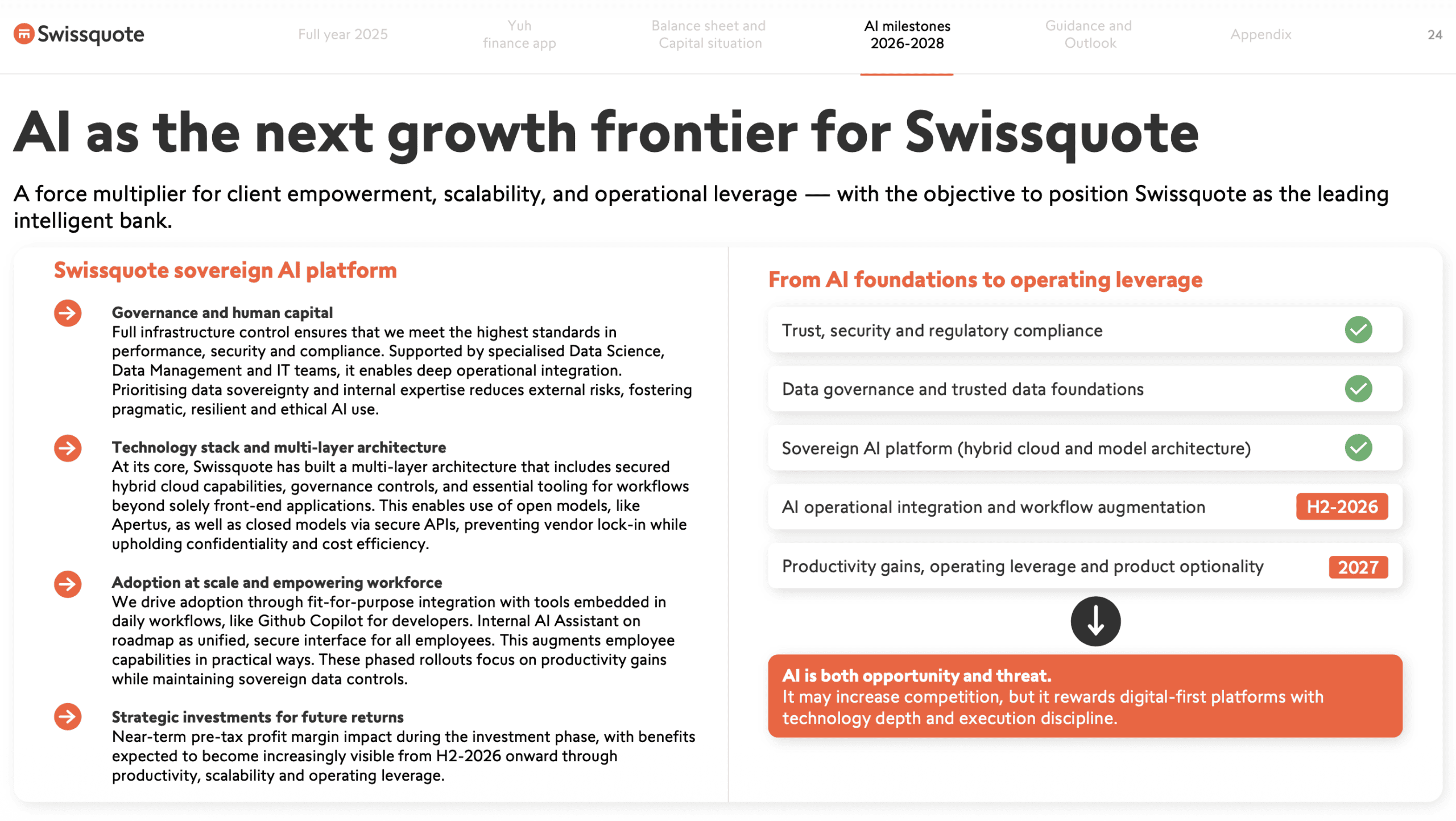
Source: Swissquote Group, 2025 results presentation (click on image to enlarge).
The stock is no longer exactly a hidden secret. Swissquote now has a market cap of CHF 6bn, and the stock is covered by 12 equity analysts. UBS most recently rated the stock "Sell", citing slowing growth rates, rising costs, margin pressure, and a valuation of 20x expected 2026 earnings.
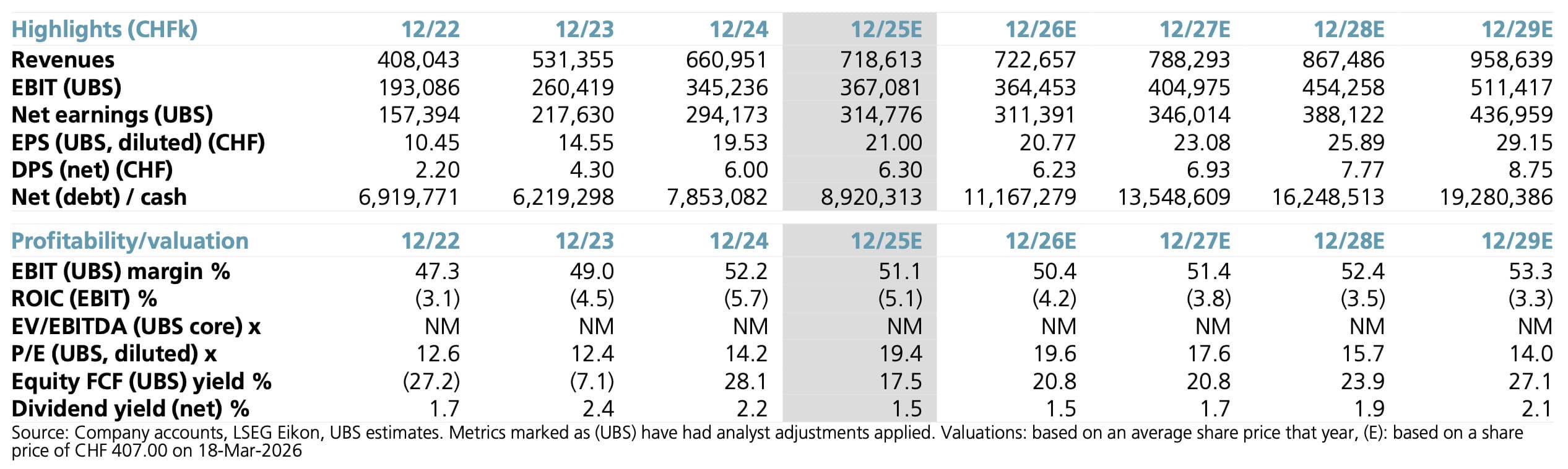
Source: UBS, 19 March 2026 (click on image to enlarge).
The stock has corrected significantly following its strong run during 2025. It now trades below CHF 400 after previously reaching as high as CHF 570.
Will accelerating growth eventually reignite the share price?
Could Swissquote ultimately face the same fate as E*TRADE and Saxo Bank?
How will the company fare in a scenario where European online brokers and neobanks consolidate into larger groups?
I have not yet conducted a full deep dive on the stock, but it is certainly one worth monitoring.
In the past, I wrote extensively about the German online broker flatexDEGIRO (ISIN DE000FTG1111, DE:FTK). That stock rallied up to 3x after I published an in-depth report at a time when it had largely fallen off investors' radar screens. I also recently published a detailed report on the Israeli online trading platform eToro (ISIN VGG320891077, Nasdaq:ETOR), which turned out to have reasonably good timing given the share price's subsequent recovery.
Online brokers and neobanks remain a fast-growing sub-sector of financial services, and they are likely to continue taking market share from traditional banks for many years to come.
In the specific case of Swissquote, I would personally wait for a more attractive entry point before considering an investment. That said, I also have a decades-long track record of waiting too long. So perhaps take that view with a pinch of salt.
One thing I do know for certain, however: for anyone looking for an accessible Swiss online bank with global brokerage services, Swissquote is well worth a look. The platform may not offer every single market worldwide, but access to 3m financial products should provide more than enough choice for most self-directed investors.
Interested readers can get an initial overview of the company by downloading its Equity Story presentation.

Missed our online conference Investing in Ukraine on 23 April 2026?
You can now access the complete event on demand – including:
6.5 hours of professionally edited session recordings
Covering on-the-ground insights, deep dives into sectors such as agriculture, defencetech and real estate, as well as investment cases, special opportunities, and more.
Full presentation slide decks
Including market data, valuation frameworks, scenario analyses, and investment cases – the exact materials used by speakers.
The Ukraine Investment Handbook
A curated digital booklet with key observations from the event, selected ancillary materials, and additional resources.
Learn what you need to understand, evaluate, and invest in Ukraine-related opportunities that are accessible through public markets – at your own pace, whenever it suits you.
Members enjoy 50% off.
Did you find this article useful and enjoyable? If you want to read my next articles right when they come out, please sign up to my email list.
Share this post:


