The island nation of Cyprus is small but offers a surprisingly diverse selection of listed companies. This includes Bank of Cyprus, Petrolina Holdings, and DCI Advisors.

Cyprus – “weird” opportunities galore
read more

Warren Buffett once claimed that Value Line was the only investment research service he subscribed to. Founded in 1931, Value Line is about as storied a brand as they come.
What hardly anyone realises is that Value Line is listed on Nasdaq.
Even fewer remember the drama that unfolded at the company over the decades: a sibling feud, and large-scale fraud – followed by a secular decline of its traditional business.
And yet, somehow, the company continues to spit out cash.
Undervalued-Shares.com decided to take a closer look at this obscure case.
If you started a career in finance in the 1990s or earlier, it is almost impossible not to have encountered Value Line (ISIN US9204371002, Nasdaq:VALU).
For decades, it was THE go-to resource for learning about publicly listed American companies.
In the 1930s, founder Arnold Bernhard started publishing a rating system that tracked the relationship between a company's share price, underlying earnings, and book value. He initially covered just 120 stocks, compiling them into a book that sold for USD 200 – a chunky price at the time! In an era marked by many market dislocations, information about stocks with a low book value had real value. Sales boomed!
From these humble beginnings grew a binder containing one-page profiles on 3,400 stocks, representing 90% of daily US trading volume. Each page combined in-depth data with Value Line's proprietary rating system. Subscribers regularly received updated sheets to replace older ones.
For decades, private investors who valued the service but could not afford it flocked to local libraries which stocked the famous Value Line binders. Some libraries even posted signs asking patrons not to rip out pages, or else risk cancellation of the subscription. At its peak, nearly 300,000 subscribers paid a significant monthly fee for the service – Warren Buffett among them.
Selling information to investors can be a lucrative business. During the 1980s, Forbes cited Value Line Inc. as the "best small company in America based on return on equity since 1982".
Bernhard built an impressive enterprise and died a wealthy man. He left his 80% stake to his twin children, Arnold Van Hoven Bernhard ("Van") and Jean Bernhard Buttner. Jean inherited two shares more than her brother – a difference that later proved consequential.
Van had stopped working in the family business in the 1970s, while Jean remained closely involved until her father's death in 1987. She assumed control of the company shortly thereafter.
Following the subsequent death of their mother, open warfare erupted between the siblings.
Jean booted Van from the company's board, prompting him to seek dissolution of the family holding, Arnold Bernhard & Co., through which the family stake was held. Van wanted the freedom to sell his shares. In the lawsuit, he accused his sister of "oppressive conduct and corporate waste", claiming that her "inexperience and autocratic manner" damaged the company's value. Jean's lawyers dismissed the allegations as frivolous, and disclosures to shareholders did not always convey the full picture. What seemed clear, however, was that Jean had gained the upper hand by stacking the board with her three children and loyal associates.
In the end, Jean had the company pay out a USD 149m special dividend. She used the proceeds to buy out her brother and secure full control.

Source: The New York Times, 28 November 1996.
This episode was only one reason she later became known as "Mean Jean". As one local newspaper reported, "she fostered a totalitarian workplace, firing employees for being two minutes late, eating lunch at their desks or making personal phone calls".
Judging someone based on media reports is rarely wise. Still, subsequent events suggest that Jean Buttner did have a quirky view on how investors and clients should be treated.

Jean Buttner (the only photo on the Internet).
In 2004, federal authorities began investigating Value Line after a whistleblower alleged inflated commissions and kickbacks from investment funds using the Value Line brand.
The investigation only came to light in 2009. One day after her 75th birthday, then-CEO Jean Buttner settled with the Securities and Exchange Commission (SEC). She admitted no wrongdoing but agreed to pay USD 45m to resolve allegations of 20 years (!) of overcharging mutual fund clients.
Notably, this was the same firm that had long marketed itself as "the most trusted name in investment research".
The SEC barred Jean from running the company. She was forced to step down and either sell the business within a year or relinquish control. In practice, she was banned from the securities industry for life.
As Crain's New York Business put it: "It was the ignominious end to the 21-year reign of one of Wall Street's most tyrannical CEOs."

Source: Crain's New York Business, 28 November 2009.
Financially, Jean landed softly. Shortly after the investigation began, she extracted another USD 175m from the company via a special dividend. Of the USD 45m settlement, she personally paid only USD 1m; the remainder was borne by the company. Her long-time legal advisor, Howard Brechner, took over as CEO. Given his position as Chief Legal Officer, some questioned how he could have been unaware of systematic overcharging.
What's most surprising?
Jean Buttner is still around, as is Howard Brechner!
Jean, now 90, is still the family matriarch. (Van died in 2018, aged 83.)
Brechner, now in his mid-70s, remains CEO and Chairman.
Arnold Bernhard & Co. controls 92% of the company's shares, and Jean's children (now themselves in their 70s) sit on the holding company's board.
Given this quirky background, how is the business doing today?
Value Line doesn't publish fancy investor relations presentations. Its annual report looks like it was designed in the 1980s.
To this day, Value Line publishes the company profiles collectively known as The Value Line Investment Survey®. Publishing revenue, however, is declining. Total publishing revenue was USD 35.3m in 2015 and USD 37.5m in 2024. Adjusted for inflation, that's a steep decline. Periodicals revenue fell from USD 32.7m to USD 25.4m over the same period. The shortfall was partially offset by copyright fees and brand-licensing royalties, mainly tied to mutual funds. Along the way, Value Line also digitised much of its publishing business. Nearly two-thirds of publishing revenue now comes from digital subscriptions.
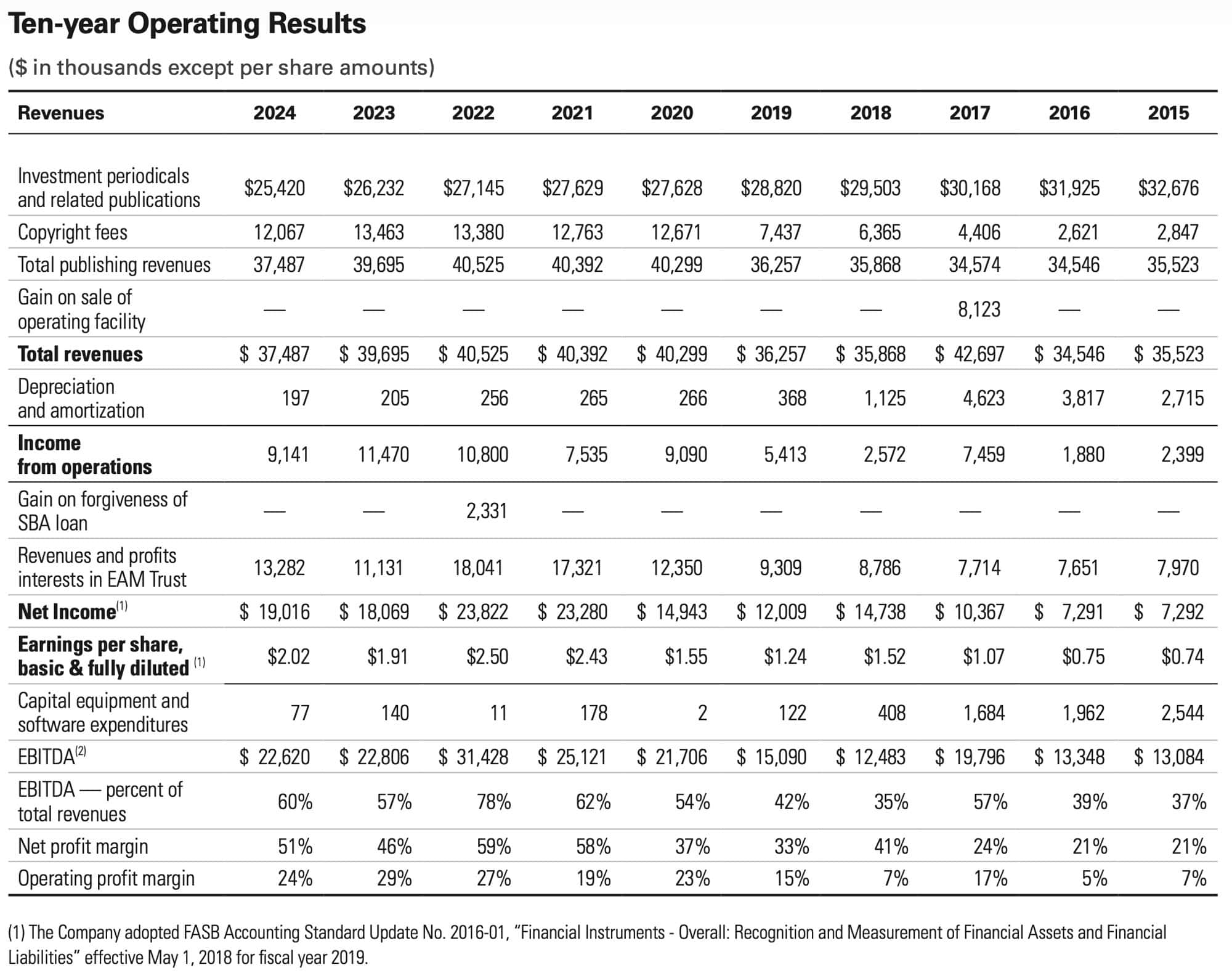
Source: Value Line Inc., 2024 Annual Report (click on image to enlarge).
It'd be easy to lambast management for not doing more to take its publishing operation into the new era of investor information. However, when you have a product that is producing millions of dollars of cashflow and lives off an almost cult-like following with subscriptions that have often been in place for decades, it's easier said than done to implement far-reaching changes.
Besides its flagship product, Value Line publishes a range of smaller and more specialised information services, from newsletters focused on special situations to publications aimed at climate-conscious investors. These are niche offerings, but they reinforce the firm's reputation for breadth and longevity.
Something Value Line has been quite successful with is finally using its brand name and customer reach to raise money for managing a series of funds. This is something management deserves credit for, and which was only built fairly recently.
Value Line first experimented with managing money as early as the 1950s, but those efforts never gained real traction. This difficulty is common across the investment publishing industry. Many firms have built powerful brands and enormous readerships, yet very few have managed to convert those relationships into substantial client assets. MarketWise (ISIN US57064P2065, Nasdaq:MKTW) and the privately held Agora Inc. are prominent examples of businesses with vast publishing reach but no significant presence in asset management.
Since restarting efforts to manage external money in 2010, Value Line has built up a range of funds that collectively manage over USD 4bn in client funds. In addition, one externally managed fund – licensed to use the Value Line brand name and certain proprietary tools – manages a further USD 8bn.
It's largely thanks to the EULAV Asset Management division (dubbed "EAM" in the company's reporting) that Value Line managed to increase net profit by 2.5x between 2015 and 2024. Net income rose from USD 7.2m to USD 19m. Over the same period, the company raised its dividend for ten consecutive years. Not bad for a 'dying' business.
Value Line today isn't just debt-free, but it also sits on more than USD 100m in cash and marketable securities.
At a share price of USD 37 and 9,405,828 shares outstanding (as of October 2025), Value Line has a market cap of about USD 350m and an enterprise value closer to USD 250m. To manage conflicts of interest and regulatory issues, Value Line holds an economic interest – but not control – in its asset management division. It's a quirky set-up that makes the company hard to value. The details are laid out in the annual report.
Relative to earnings, balance sheet assets, and client assets under management, the stock appears neither outrageously cheap nor particularly expensive. What does make it problematic as an investment is concentration risk. As disclosed in the annual report, 33% of the publishing division's print revenue comes from a single customer. The identity of that customer remains a mystery. If that relationship were to end, it's not hard to imagine the profitability of the publishing division suffering a severe setback.
That alone makes the stock difficult to underwrite for anything other than curiosity value. With 92% of the share capital controlled by Arnold Bernhard & Co., just 8% (or 750,000 shares) are available. Over the past ten years, the family has bought back 6% of the share capital. While that may not sound aggressive, it reduced the company's free float by 43% over a decade. In effect, Value Line is slowly self-cannibalising its status as a public company. Last year, the company announced another share buyback programme of up to USD 2m, with no time limit for execution.
The stock might become more interesting if Value Line were ever to consider formally separating its publishing and asset management divisions. The publishing division still houses a range of products, and in theory there could be a way to breathe new life into this division. In practice, however, the likelihood of such a split – let alone its feasibility – appears quite low.
Another special dividend is always possible, but that wouldn't provide sustainable uplift.
Even during the dotcom boom, Value Line's stock never truly took off, as the firm's value-oriented methodology seemed outdated. The stock did enjoy a brief moment of glory during the pandemic, but has since flatlined once again. In effect, the share price has moved sideways for three decades – a long time, given that the Dow Jones Index rallied by a factor of ten over the same period. As Barron's once observed in a 2003 article, Value Line has "a knack for squandering promising opportunities". That assessment still feels uncomfortably apt.

Value Line.
Then again, for a family already wealthy beyond any reasonable need, Value Line did not perform badly at all. If Jean's family reinvested decades of dividends into index funds, they may well rank among the many invisible billionaires.
Value Line's strategy of offering high-quality, independently sourced information and analysis for all types of investors is a service from a different era – in a good way. The firm's success in raising a few billion dollars from savers is also commendable, and this part of the business is likely to continue growing, as the Value Line brand retains relevance and credibility among an older demographic.
That said, Value Line is effectively a private company dominated by a family that are accustomed to doing things their own way. The family shareholders almost certainly have more money than they could ever need, and the key figures are likely now too old to pursue anything beyond maintaining the status quo.
Rich heirs will be happy with a 3.3% dividend yield and a share price that drifts sideways indefinitely. Customers still enjoy the products. It's shareholders, however, who have little to get excited about. Ongoing share buybacks will likely lead the company towards an eventual going private. Based on precedent, it would be optimistic to expect that such an offer would be overly generous.
The London market is littered with companies left over from previous eras.
Some of them are wound up, with capital returned to shareholders. When that happens, investors can benefit from a meaningful gap between the share price and the company's net asset value.
A smaller subset, however, follows a different path: after liquidation, the listed entity survives as an empty shell, ready to be recycled as a vehicle for a backdoor listing.
The latest Undervalued Shares research report – out this week – features one such case that looks particularly interesting – and potentially imminent.

The London market is littered with companies left over from previous eras.
Some of them are wound up, with capital returned to shareholders. When that happens, investors can benefit from a meaningful gap between the share price and the company's net asset value.
A smaller subset, however, follows a different path: after liquidation, the listed entity survives as an empty shell, ready to be recycled as a vehicle for a backdoor listing.
The latest Undervalued Shares research report – out this week – features one such case that looks particularly interesting – and potentially imminent.
Did you find this article useful and enjoyable? If you want to read my next articles right when they come out, please sign up to my email list.
Share this post:


