Can shareholders instigate change by writing letters to boards? Can doing so catalyse a re-rating?

Writing letters to boards – an effective catalyst?
read more

In 2022, I wrote about the "weird" special situation of a London-listed miner.
It was a controversial company because of its Russian origin, but it offered the opportunity to acquire gold mining assets almost for free.
In 2024, the same stock was pitched at the annual Weird Shit Investing conference.
Over the past few years, the stock is up 3x.
Remarkably, anyone who bought back then now effectively owns the stock at less than 1x forward earnings. It is a case study in picking up world-class assets during a proverbial fire sale.
A new research report outlines the conditions under which the stock could triple again from its current price.
The background story of this company spans a remarkable number of jurisdictions.
What is today known as Solidcore (ISIN JE00B6T5S470, KZ:CORE) was previously called Polymetal International, a mining company founded by Alexander Nesis, the Russian entrepreneur and private equity investor. In 2011, Polymetal listed on the London Stock Exchange. At the time, it enjoyed strong backing from British ultra-high-net-worth investors and fund managers who wanted exposure to the company's lucrative Russian gold mining assets.
By the time of the London listing, the company had already expanded into Kazakhstan. In 2014, it bought additional Kazakh mining assets. To reflect its growing presence there, Polymetal also listed on the Astana International Exchange (AIX). In retrospect, this diversification turned out to be the move that ultimately saved the company and created today's opportunity.
The company operated through a corporate domicile in Jersey, the self-governing financial centre in the English Channel. Like many international companies, Polymetal used Jersey as a convenient place to maintain a corporate headquarters, even if that largely amounted to directors occasionally meeting on-island to formally approve decisions. To some, this governance model resembles a post-box company structure. To be clear, however, this was far from an average junior gold miner. At its peak in 2020, Polymetal was worth GBP 9.5bn (USD 11.4bn).
Following Russia's invasion of Ukraine in 2022, what was then still Polymetal became caught up in sanctions against Russian business operations. Neither the company itself nor its executive team were ever sanctioned. The Kazakh operations also remained unaffected. Nevertheless, many – though not all – Western brokers stopped accepting orders to buy the stock. Shareholders became concerned about the company's future, and the share price collapsed by 90%.
Clearly, something had to change for both the company and the investment case to remain viable. At the time, several companies that had become entangled in sanctions-related chaos despite not being sanctioned themselves began restructuring their corporate set-ups in order to establish a more sustainable footing.
Undervalued-Shares.com identified this particular case at a very early stage. Sensing that Polymetal was likely to take steps to break free from the bind it had found itself in, I published an article in July 2022 titled "Polymetal: how to buy Russian gold mines for free".
At the time, buying Polymetal stock effectively meant paying 3x EV/EBITDA for the Kazakh gold mines while receiving the Russian mines for free as future optionality. I pointed out that the company was already evaluating a split of the two businesses, which could become a powerful catalyst. In an ideal scenario, the Russian operations would eventually be sold, leaving the remaining Kazakh business intact and backed by substantial cash proceeds.
This set-up also attracted the attention of Thomas Bachrach of PFH Capital in Philadelphia. In June 2024, he presented the investment case at the Weird Shit Investing conference that I host annually in Hong Kong, London, and New York.
By that stage, the story had already evolved considerably. What was once Polymetal had by then already:
Kazakhstan increasingly wanted to position itself as something akin to what Yugoslavia represented during the 1980s – a country seeking to remain useful to both sides of the Iron Curtain. Polymetal similarly wanted to position itself as neither distinctly Russian nor Western. With operations focused on Kazakhstan and a sole listing in Astana, the company aimed to become a "politically" neutral mining group.
The cancellation of the London listing was unfortunate, but probably necessary in order to give the company a fresh start. In retrospect, this is also what created the opportunity. Investors fearing the loss of the London listing sold the stock at proverbial fire-sale prices. By the time the investment case was presented at the conference, the only remaining listing was in Astana – an exchange requiring specialised frontier-market access. As a result, the stock continued trading at a low multiple. Thomas highlighted this dynamic in his presentation, which is available in the free Weird Shit Investing Manual 2024.
The lack of liquidity remains an issue today, and the company has become almost invisible to international investors. Nevertheless, the share price is now up 3x since the investment case was presented at the Weird Shit Investing conference – and the same compared to when I first wrote about it.
With its origins as a Russian company increasingly fading into the rear-view mirror, Solidcore is now attempting to chart a new path as a Kazakh – and potentially global – mining company.
Indeed, the stock may now be about to re-emerge on investors' radar screens.
At the end of April, Roemer Capital – a brokerage firm specialised in frontier markets and special situations – initiated coverage of the stock with a 24-page research report.
The report highlights that Solidcore is one of the three largest producers in Kazakhstan, alongside Glencore-owned Kazzinc and Altynalmas. Solidcore currently produces around 500,000 ounces of gold per year. Together, these three companies account for more than 35% of Kazakhstan's gold production.
As a resource-rich country that had relatively limited access to capital until the collapse of the Soviet Union, Kazakhstan remains an attractive mining jurisdiction. Solidcore's existing operations currently have estimated mine lives extending until 2042 and 2054, respectively. With projected production costs of USD 1,850-2,050 per ounce in 2026, the company sits broadly in the middle of the industry's global cost curve.
Over the coming years, Solidcore aims to improve vertical integration (= make gold production more efficient) and strengthen its production outlook (= produce more gold). Later this year, the company is expected to complete a pending acquisition in Kazakhstan. It is also evaluating mining opportunities in Oman and Saudi Arabia. With 31.7% of the company owned by an Omani investor, Solidcore should be able to lean on a number of local relationships when expanding into Oman or other underexplored parts of the Middle East.
By 2030, management intends to double annual production to 1m ounces of gold. By the end of the decade, the company plans to increase reserves to 20-25m ounces, extending estimated mine life into the early 2050s.
What sort of valuation does the market currently assign to this overall set-up?
Roemer Capital estimates that the stock is currently trading at
This is not just cheap in absolute terms. According to Roemer Capital, Solidcore trades at a 60% discount to comparable emerging-market gold miners.
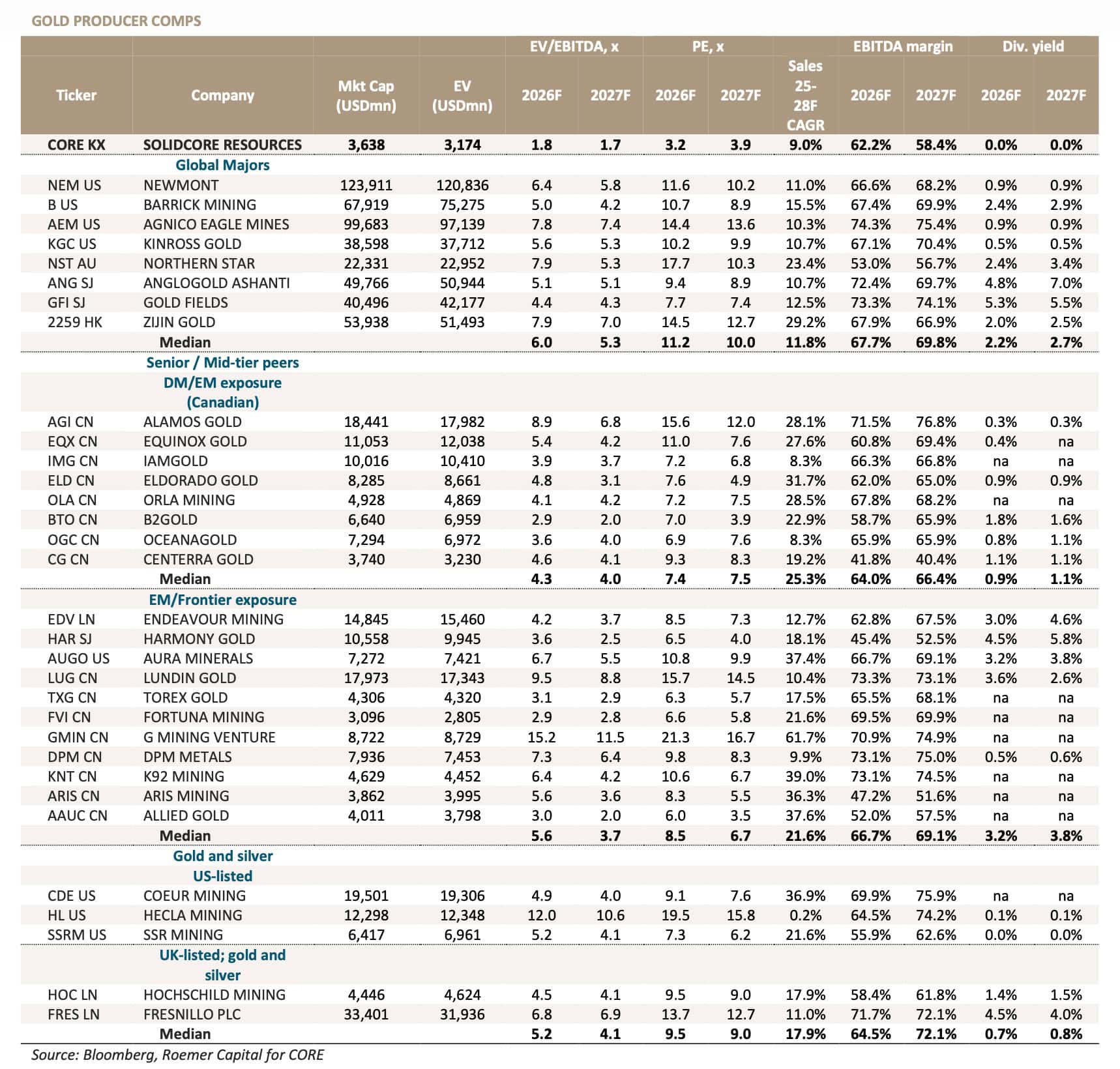
As if this valuation were not already attractive, there is another twist.
If you read the full report carefully, you will notice that the estimates are based on a gold price assumption of USD 4,200 per ounce for 2026. Gold is currently trading closer to USD 4,700 per ounce. For 2027 onwards, Roemer Capital actually uses *declining* gold price assumptions. The 2028 estimates, for example, are based on a gold price of just USD 3,800 per ounce. This is somewhat unusual, because most equity analysts covering gold miners broadly extrapolate current spot prices into future years. Roemer Capital instead appears deliberately conservative, likely accounting for the possibility of a correction following gold's powerful rally during 2025.
The report also makes a number of other cautious assumptions:
In my view, it is fairly clear what Roemer Capital is doing – and it is probably a smart strategy. By starting with conservative assumptions, the brokerage firm lays the groundwork for future upgrades further down the road.
For Solidcore, the lack of a major international listing is simultaneously a problem and an opportunity. Trading liquidity is unlikely to improve materially while the stock remains listed only in Astana, which naturally limits investor participation. However, a future re-listing on a larger international exchange could become a powerful catalyst and drive a substantial multiple re-rating. Even a credible indication that management is considering such a move could attract investors seeking to front-run that development.
There are clear precedents for this. London-listed Endeavour Mining (ISIN GB00BL6K5J42, UK:EDV), for example, operates gold mines in jurisdictions such as Côte d’Ivoire, Burkina Faso, and Senegal. Had those assets been listed solely on a small regional exchange, they would likely attract far less investor attention and trade on significantly lower valuation multiples. Being listed in London under a larger corporate structure made a substantial difference. Despite the bad news associated with parts of West Africa, Endeavour Mining's stock is up 3x since early 2025, and the company is now worth GBP 11bn (USD 15bn). Importantly, Endeavour Mining trades at twice the valuation multiple of Solidcore, despite Kazakhstan arguably representing the lower-risk jurisdiction.

Endeavour Mining.
It is also worth considering Solidcore's valuation in absolute terms. Valuations across the global gold mining sector remain subdued and may remain so for various reasons. Still, if the company continues trading at 1.2x EV/EBITDA based on a conservative gold price assumption of USD 3,800 in 2028, there is a reasonable chance that the stock appreciates materially over time regardless. Solidcore may also soon resume dividend payments. Following the resolution of several legacy technical issues, the company could restart distributions to shareholders. Two of the three remaining hurdles are cleared already, with the third expected to be resolved by mid-2026.
In a more optimistic scenario, Solidcore could:
Under such a scenario, and given the current valuation multiples, another 3x move from current levels would not appear especially far-fetched.
To be clear, Solidcore is not a tiny frontier-market small-cap. The company currently has a market cap of USD 3.7bn. The low trading volume is probably driven more by a lack of demand than a lack of supply. Given the company's market cap and the presence of legacy owners, investors looking to deploy meaningful capital would likely still be able to source sizeable blocks of stock.
For anyone looking to learn about this in more detail, you can always try to convince Roemer Capital to share a copy of the report with you. The brokerage firm is a member of the AIX, i.e. it can execute trades in Kazakhstan for its (mostly institutional) clients. The research report they published on Solidcore offers a wealth of information and is also of interest to anyone who is looking at emerging and frontier market gold miners in general.
With the team of Solidcore confirmed to visit London in early June 2026, the first catalyst for growing investor interest may already be on the near-term horizon. I have a sense that this emerging story is going to receive a lot more attention soon.
In four weeks' time, I will once again host the Weird Shit Investing conference. The event is structured as a think-tank-style gathering where participants in Hong Kong (11 June), London (16 June), and New York (18 June) will present nearly 50 investment ideas that most investors are unlikely to have encountered before.
Each of these ideas will also appear in the forthcoming "Weird Shit Investing Manual 2025" in the form of one-page summaries – free for all subscribers of the Weekly Dispatches!

Missed our online conference Investing in Ukraine on 23 April 2026?
You can now access the complete event on demand – including:
6.5 hours of professionally edited session recordings
Covering on-the-ground insights, deep dives into sectors such as agriculture, defencetech and real estate, as well as investment cases, special opportunities, and more.
Full presentation slide decks
Including market data, valuation frameworks, scenario analyses, and investment cases – the exact materials used by speakers.
The Ukraine Investment Handbook
A curated digital booklet with key observations from the event, selected ancillary materials, and additional resources.
Learn what you need to understand, evaluate, and invest in Ukraine-related opportunities that are accessible through public markets – at your own pace, whenever it suits you.
Members enjoy 50% off.
Did you find this article useful and enjoyable? If you want to read my next articles right when they come out, please sign up to my email list.
Share this post:


